
Uraan Pakistan: National Economic Transformation Plan (2024-2029)
Overview
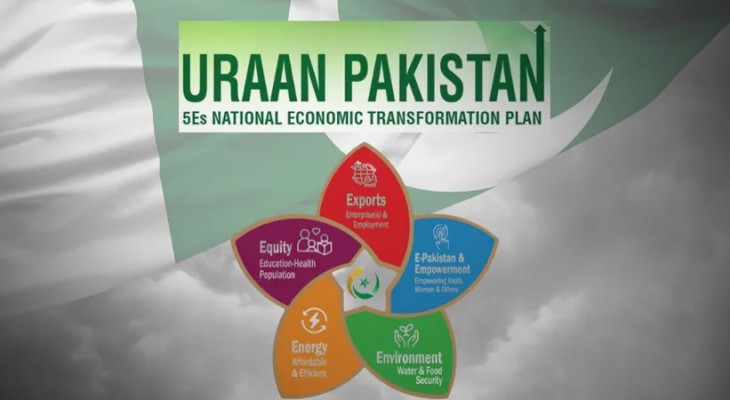
Uraan Pakistan, officially the National Economic Transformation Plan (2024-2029), is a strategic roadmap launched on December 31, 2024, by Prime Minister Shehbaz Sharif to rejuvenate Pakistan’s economy. It addresses macroeconomic instability, structural fiscal deficits, and weak export performance through a homegrown, evidence-based approach. The plan aligns with the 13th Five-Year Plan and is executed by the National Economic Transformation Unit (NETU).
The 5Es Framework
The plan is structured around five key pillars, known as the “5Es”:
- Exports:
- Goal: Achieve $60 billion in annual exports by 2029, doubling current levels, by prioritizing IT, manufacturing, agriculture, minerals, manpower, and the blue economy.
- Strategies:
- Rebrand “Made in Pakistan” as a global quality standard.
- Expand trade agreements (e.g., EU’s GSP+, ASEAN, GCC FTA).
- Reduce import dependency to stabilize the rupee.
- Context: Pakistan’s economy has been import-heavy, leading to balance-of-payment issues when growth exceeds 4%. Export-led growth is seen as critical to sustainable development.
- E-Pakistan:
- Goal: Boost ICT exports to $5 billion, produce 200,000 IT graduates annually, achieve one unicorn startup, and reach 100 million next-generation mobile subscribers.
- Strategies:
- Establish “Quantum Valley” for nanotechnology and quantum computing.
- Promote freelancing and startup ecosystems.
- Enhance AI adoption and mobile connectivity.
- Context: Digital transformation aims to improve competitiveness and leverage Pakistan’s youthful population.
- Environment, Food, and Water Security:
- Goal: Reduce greenhouse gas emissions by 50%, increase water storage by 10 million acre-feet, and expand cultivable land by 20.3 million acres.
- Strategies:
- Implement sustainable agricultural practices and green technologies.
- Enhance disaster resilience and water conservation.
- Context: Climate change, exemplified by the 2022 floods ($40 billion in damages), underscores the need for environmental sustainability.
- Energy and Infrastructure:
- Goal: Increase renewable energy to 10% of the energy mix, reduce circular debt, boost railway transport (passengers from 5% to 15%, freight from 8% to 25%), and complete mega dams.
- Strategies:
- Develop affordable, green energy solutions.
- Modernize transport corridors and mining infrastructure.
- Context: Energy inefficiencies and circular debt (Rs 2–3 trillion) hinder industrial growth, necessitating reforms.
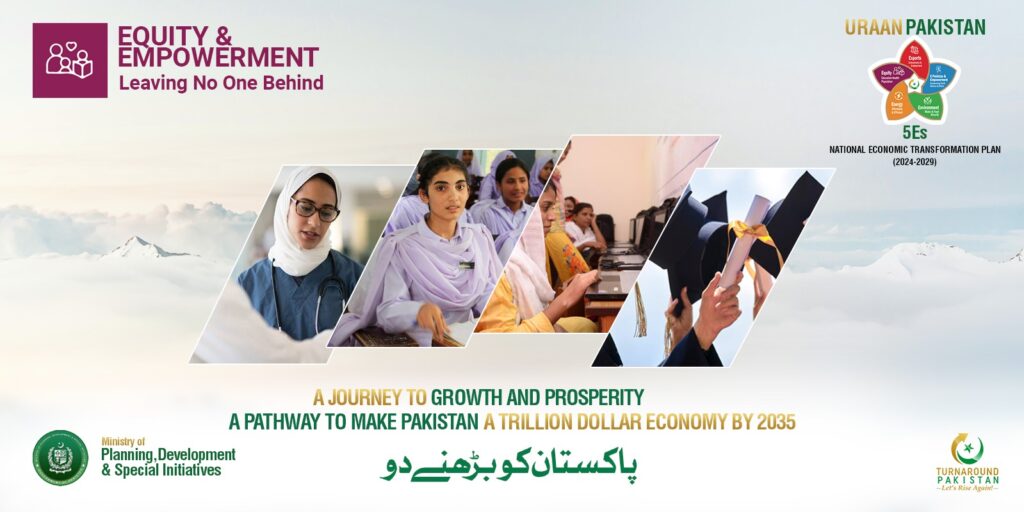
- Equity, Ethics, and Empowerment:
- Goal: Improve universal health coverage by 12%, literacy by 10%, female labor force participation by 17%, and reduce youth unemployment by 6%.
- Strategies:
- Enhance healthcare and education systems.
- Promote gender equality and youth empowerment through programs like the Prime Minister’s Laptop Scheme and Youth Leadership Awards.
- Context: Social equity is critical to ensure inclusive growth and reduce disparities.
Key Objectives
- Economic Growth: Achieve a sustainable GDP growth rate of 6% by 2028.
- Job Creation: Generate 1 million jobs annually.
- Investment: Attract $10 billion in private investment per year.
- Macroeconomic Stability: Reduce fiscal deficits, control inflation, and build foreign reserves.
- Long-Term Vision: Transform Pakistan into a $1 trillion economy by 2035 and $3 trillion by 2047, potentially joining the G-20.
Implementation Mechanism
- National Economic Transformation Unit (NETU):
- Coordinates with government agencies, private sector, academia, and international partners (e.g., IMF, World Bank, ADB).
- Monitors progress using Key Performance Indicators (KPIs), quarterly reviews, and a Results-Based Management (RBM) framework.
- Delivery Unit: Established at the Prime Minister’s Office to oversee sectoral plans and ensure accountability.
- Champions of Reforms Network: Engages professionals for policymaking and governance.
- Public-Private Partnerships: Encourages private investment and collaboration, with support from the Special Investment Facilitation Council (SIFC).
- China-Pakistan Economic Corridor (CPEC): Identified as a cornerstone for infrastructure and economic development.
Challenges and Criticisms
- Implementation Gaps: Critics note a lack of specificity in execution strategies, with past plans hindered by poor governance and political instability. Effective implementation requires a competent economic team and a conducive business environment.
- IMF Constraints: Pakistan’s 25 IMF programs highlight a reliance on external borrowing, with 2025’s Extended Fund Facility ($7 billion) imposing conditionalities that may limit fiscal flexibility.
- Political Unity: The plan emphasizes a “Charter of Economy” for political consensus, but opposition from parties like PTI, as noted on X, may create obstacles.
- Funding: Financing a $1 trillion economy by 2035 is ambitious, with doubts about securing $10 billion annually in private investment given Pakistan’s 108th ranking in the World Bank’s Ease of Doing Business Index (2020).
- Climate and Structural Issues: Environmental challenges (e.g., 2025 floods in KP) and inefficiencies in state-owned enterprises (Rs 6 trillion in losses over a decade) pose risks to sustainable growth.
Context and Rationale
- Economic Background: Pakistan has faced declining exports, reliance on imports, low productivity, and a drop from the 24th to the 47th largest economy globally. The plan aims to reverse this through export-led growth and structural reforms.
- Global Inspiration: Models like South Korea and Singapore, which prioritized exports, digital innovation, and social equity, inform Uraan Pakistan’s approach.
- Citizen Engagement: Transparent implementation and public involvement are emphasized to build trust and ownership.
Pingback: Social Media Regulation in Pakistan and cyber crime Loose - Fact Hub
Your point of view caught my eye and was very interesting. Thanks. I have a question for you.