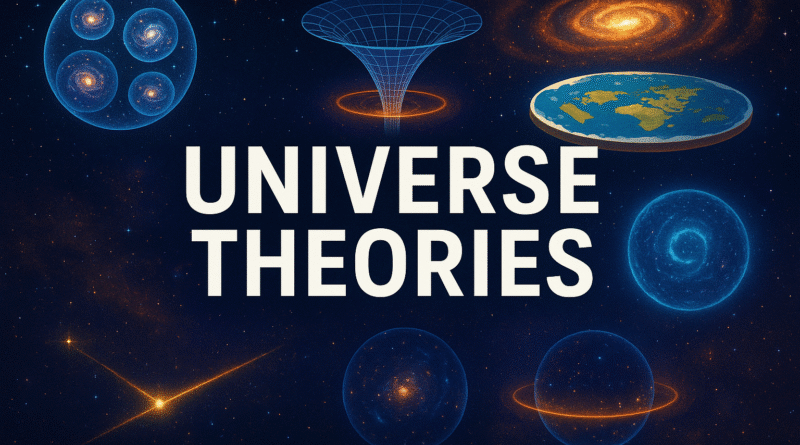
Universe Theories
The main theory for the universe’s origin is the Big Bang Theory, which states the universe began from an extremely hot, dense point and has been expanding for about 13.8 billion years.
Other theories include the Steady State Theory, which is now largely disproven, the Multiverse Theory, which suggests other universes exist, and the Inflationary Model, an extension of the Big Bang theory.
Dominant theories about Universe
Big Bang Theory:
The most widely accepted model, proposing the universe began from a single point of immense heat and density that expanded outward.
Evidence includes the cosmic microwave background radiation, the abundance of light elements, and the expansion of the universe.
When: ~13.8 billion years ago.
Evidence
Cosmic Microwave Background (CMB) radiation – the “afterglow” of the Big Bang, discovered in 1965
Redshift of galaxies – galaxies are moving away from us (Hubble’s Law),
meaning the universe is expanding
Large-scale structure of the universe (galaxy clusters, filaments, voids)
Cosmic inflation (1980s–present):
A tiny fraction of a second after the Big Bang, the universe expanded exponentially fast, explaining why it’s so flat and uniform
The universe is now 93 billion light-years across (observable part).
Inflationary Model:
An addition to the Big Bang theory that suggests a period of extremely rapid, exponential expansion in the first fraction of a second after the Big Bang.
Backing Theories
Steady State Theory:
An older theory that suggested the universe was expanding but had always existed and was continuously creating new matter to maintain a constant density.
This theory lost favor after the discovery of cosmic microwave background radiation.
Multiverse Theory:
A concept that posits our universe is one of many, potentially with different physical laws.
This is a speculative idea that arises from several areas of physics, such as inflation and quantum mechanics.
Other concepts
Cosmological Constant
A term added by Einstein to his equations that accounts for the universe’s accelerated expansion, a phenomenon attributed to “dark energy”.
Dark Matter and Dark Energy
These are hypothetical forms of matter and energy that make up about 95% of the universe’s content and are needed to explain observed phenomena like galaxy rotation and the accelerating expansion of the universe.
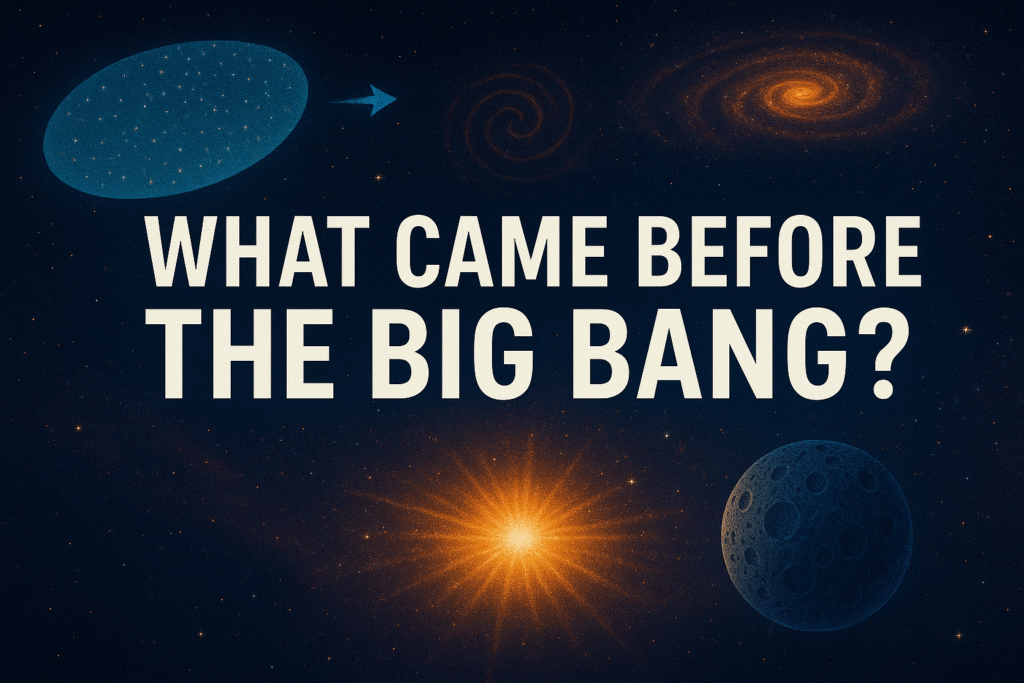
What Came Before the Big Bang?
Quantum gravity theories (e.g., Loop Quantum Gravity, String Theory):
The singularity may not have existed; instead a “quantum bounce” or transition from a previous contracting phase.
Eternal Inflation:
Our universe is one bubble in an eternally inflating multiverse.
Hartle–Hawking “No Boundary” Proposal:
Time didn’t exist “before” the Big Bang — the universe has a finite past but no beginning (like the South Pole has no “south of it”).
Alternative Scientific/Cosmological Models
Steady State Theory (1948–1960s, Fred Hoyle et al.)
Plasma Cosmology & Electric Universe (fringe theories)
Claim electromagnetic forces, not gravity, dominate cosmic evolution. Not accepted by mainstream science.
Modified Gravity Theories (MOND, f(R) gravity, etc.) Try to explain galaxy rotation without dark matter, but don’t usually address the origin.
Current Frontiers (as of 2025)
James Webb Space Telescope (JWST) data has shown surprisingly massive and mature galaxies only ~300–500 million years after the Big Bang → tension with standard ΛCDM model, prompting tweaks or new physics
Gravitational wave detectors (LIGO, future LISA) may eventually detect primordial gravitational waves from inflation.
Quantum computers are being used to simulate early-universe conditions.
Religious & Philosophical Origins
Abrahamic (Judaism, Christianity, Islam):
God created the universe ex nihilo (out of nothing) in Genesis / Quran
Hindu:
Cyclic universe (kalpas) with creation and destruction by Brahma/Vishnu/Shiva; current cycle ~8.6 billion years old in some calculations
Buddhist:
No ultimate beginning; cyclic universes arising and passing away.
Indigenous & ancient myths: World egg, cosmic serpent, emergence from chaos (Greek Chaos, Norse Ginnungagap, etc.)