
The Secret History Of The Indus Valley
The elusive “secret history” of the Indus Valley Civilization: an enigma for centuries
Despite being one of the world’s earliest urban cultures, the Indus Valley Civilization (also known as the Harappan Civilization) remains shrouded in mystery, leading to much speculation about its “secret history”. Here’s a breakdown of what makes it so enigmatic:
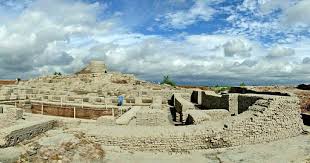
ABOVE IMAGE: Old Indus Valley
1. Undeciphered script
- The Indus Valley Civilization developed a unique writing system with over 400 symbols, but it remains undeciphered to this day.
- This lack of understanding of their script severely limits our knowledge of their political, social, and religious structures.
2. Unknown decline
- The reasons behind the collapse and disappearance of the Indus Valley Civilization around 1900 BCE are still debated among scholars.
- Various theories have been proposed, including:
- Climate change: Shifts in monsoon patterns leading to droughts and affecting agriculture.
- Tectonic events: Potentially diverting river systems and impacting water availability.
3. Absence of monumental structures
- Unlike contemporary civilizations in Mesopotamia and Egypt, the Indus Valley Civilization cities lack grand palaces or temples that would offer clear evidence of their religious practices or political organization.
- This has led to speculation about whether their religious ceremonies were confined to smaller, less identifiable structures or even within individual homes.
- Debated social structure and governance
- While the advanced urban planning and standardized weights and measures suggest a high degree of social organization and administrative control, the exact nature of their political structure remains a subject of speculation.
- The lack of clearly differentiated housing or burial practices makes it difficult to definitively determine the presence and extent of social stratification.
4. Potential for continued research and discoveries
- The majority of Indus Valley sites remain unexcavated, offering hope that future archaeological discoveries and advancements in technology like computational linguistics might shed more light on this enigmatic civilization.
- Studies comparing the Indus script with other ancient writing systems and archaeological evidence continue to be conducted in hopes of a breakthrough in decipherment.
5. Urbanism and Society
- Planned Cities: The IVC is renowned for its well-planned cities, featuring sophisticated urban planning, grid patterns, elaborate drainage systems, and standardized brick sizes. Examples include Mohenjo-daro, Harappa, Dholavira, and Lothal.
- Social Structure: While not fully understood, evidence points towards some degree of social stratification, inferred from differences in house size, craft specialization, and the presence of distinct neighborhoods for artisans and merchants. However, some aspects suggest a relatively egalitarian society, with most houses having access to water and drainage.
- Governance: The existence of standardized weights, measures, and city planning suggests a degree of administrative control, but whether a single state or city-states governed the region is still debated.
- Decline of the Indus Valley Civilization
- Multiple Theories: The end of the IVC around 1900 BCE was likely not due to a single cause, but rather a combination of factors.
- Climate Change: A shift in monsoon patterns leading to droughts and reduced water supply is widely considered a major contributor. Some researchers suggest that the drying up of the Saraswati River was particularly significant.
- Environmental Degradation: Over-exploitation of resources, including deforestation and overgrazing, may have damaged the environment and contributed to the civilization’s decline.
- River Shifts and Flooding: Tectonic activity or natural river dynamics could have shifted river courses, disrupting water supplies and potentially causing devastating floods, as evidenced by silt deposits in cities.
- Decline in Trade: The reduction or cessation of trade with civilizations like Mesopotamia might have weakened the IVC’s economy.
- Aryan Invasion Theory: Once popular, this theory suggesting an Aryan invasion as the cause of decline has been largely discredited due to a lack of strong evidence.
- Shift to Smaller Communities: Rather than a sudden disappearance, many scholars now believe the civilization experienced a de-urbanization, with people migrating eastward and southward, forming smaller agricultural communities.
6. Ongoing Research and Discoveries
- Decipherment Efforts: Scholars continue to work towards deciphering the Indus script, recognizing its potential to reveal much more about the civilization’s history and culture.
- New Discoveries: Archaeological excavations continue to unearth new artifacts and sites, offering new insights into the Indus Valley Civilization. Examples include the study of skeletal remains at Harappa, which suggest migration and a more cosmopolitan population than previously thought, and investigations into the pre-occupation history of sites.
- Uncertainties Remain: Despite the wealth of archaeological evidence, many aspects of the Indus Valley Civilization remain shrouded in mystery, awaiting further research and breakthroughs in understanding their script and socio-political organization.
Geographical overview
The Indus Valley Civilization (IVC) was a Bronze Age civilization that flourished in the basins of the Indus River and the seasonal Ghaggar-Hakra River (often associated with the lost Saraswati River) in the northwestern regions of South Asia. Its geographical extent was vast, making it the most expansive of the three earliest civilizations, which also included ancient Egypt and Mesopotamia. Key features of the geography
- River Systems: The civilization primarily developed along the fertile floodplains of the Indus River and its tributaries, and the Ghaggar-Hakra river system.
- Mountains and Deserts: The Indus Plain was bordered by high mountains to the west and north, including the Himalayas, Karakoram, and Hindu Kush ranges, as well as the Thar Desert to the east.
- Coastal Regions: Coastal settlements were found along the Arabian Sea, particularly on the Makran coast in Balochistan and in Gujarat, extending from Sutkagan Dor to Lothal.
- Fertile Plains: The annual floods of the Indus River deposited fertile silt, creating ideal conditions for agriculture in the region.
Extent and reach
The IVC covered a vast area, stretching from Balochistan to western Uttar Pradesh and from northeastern Afghanistan to Gujarat. Notable sites include major urban centers like Harappa, Mohenjo-Daro, and Ganeriwala in Pakistan, and Dholavira, Kalibangan, Rakhigarhi, Rupar, and Lothal in India. An Indus Valley site, Shortugai, has been found on the Oxus River in Afghanistan. Significance of the location
The fertile floodplains supported an agricultural economy with crops such as wheat, barley, and cotton. The region offered access to valuable resources and facilitated extensive trade networks with areas as far as Afghanistan, Persia, and Mesopotamia.
These geographical factors also supported the development of advanced urban centers.
Impact on the decline The civilization’s reliance on monsoons and rivers meant that changes in these systems, such as a weakening of monsoons or shifts in river courses, may have contributed to its decline and the abandonment of cities around 1900 BCE
Indus Valley Civilization: Daily life, religion, art, and decline
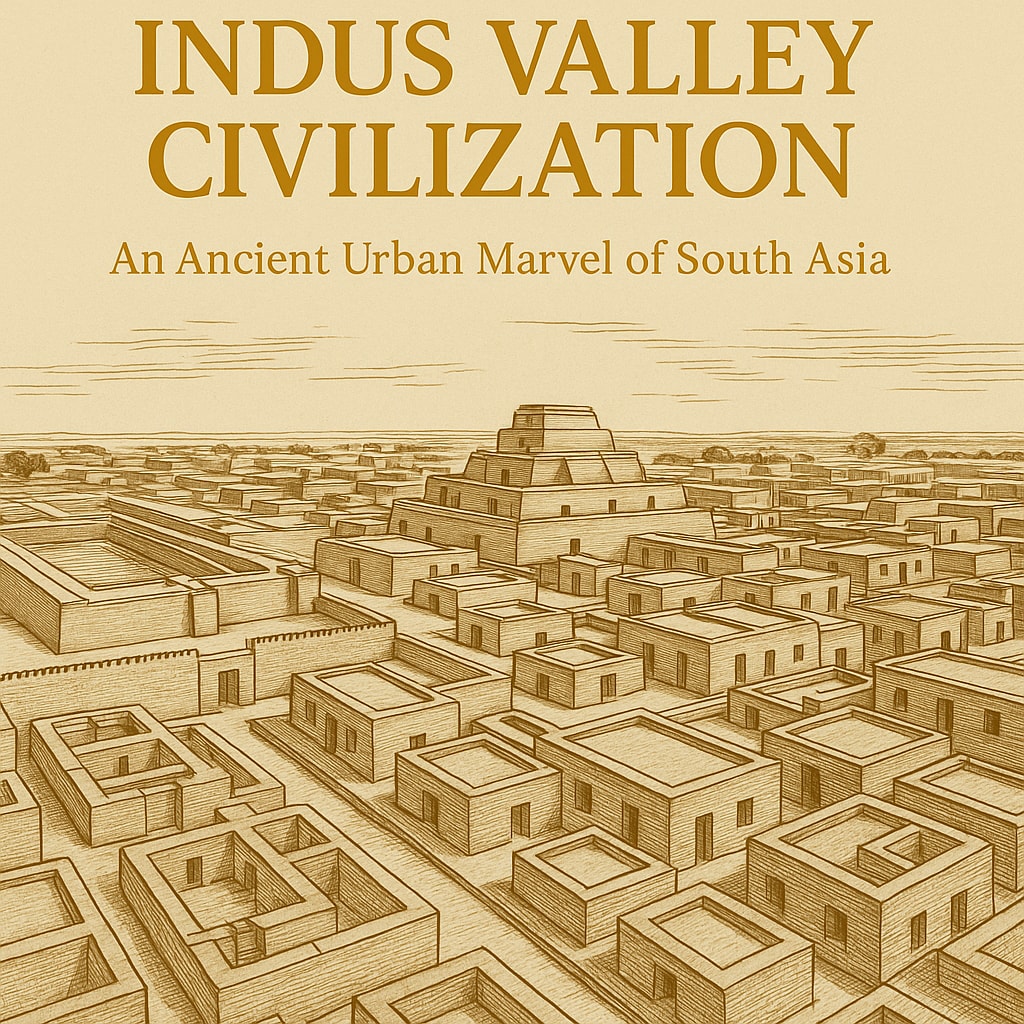
Building upon the geographical overview, here’s more information about daily life, religion, art, and decline of the Indus Valley Civilization (IVC):
1. Daily life and society
- Peaceful and Prosperous: Archaeological findings suggest a society marked by peace and prosperity, with little evidence of large-scale warfare or military organizations.
- Urban and Rural Settlements: Life in the IVC included both large, planned cities like Harappa and Mohenjo-Daro, and numerous smaller farming villages.
- Cleanliness and Sanitation: The people of the IVC, especially in the cities, valued cleanliness and hygiene, as evidenced by their advanced drainage systems, covered drains, and well-connected houses with access to water and drainage facilities.
- Agriculture and Food: The basis of their economy was agriculture, with crops such as wheat, barley, peas, lentils, mustard, sesame, and cotton grown. They also raised domesticated animals including cattle, pigs, goats, sheep, chickens, and possibly elephants. Hunting and fishing supplemented their diet.
- Craft Specialization: There’s evidence of specialized crafts, including pottery, beadmaking, shell-working, and metallurgy using copper, bronze, lead, and tin.
- Transportation: The Harappans utilized wheeled carts, likely pulled by oxen, for shortdistance transport. They also engaged in extensive river and maritime trade, with archaeological evidence pointing towards the existence of seagoing vessels.
- Religious practices
- Mother Goddess: It is widely believed that the Harappans worshipped a Mother Goddess, symbolizing fertility, as suggested by numerous terracotta figurines.
- Absence of Temples/Palaces: Unlike contemporary civilizations like Egypt and Mesopotamia, the IVC lacked grand temples or palaces, suggesting a different approach to religious practices and potentially a less centralized religious hierarchy.
- Symbolic Imagery: Many seals depict animals, some in procession or with mythical creatures like unicorns, possibly signifying religious or mythological importance. A seal depicting a horned figure surrounded by animals, interpreted by some as Pashupati (Lord of Animals), suggests connections to later Hindu deities like Shiva.
- Ritualistic Practices: The Great Bath at Mohenjo-daro may have been used for public or ritual bathing, suggesting a possible emphasis on purification rites. Testbook says Fire altars found at sites like Kalibangan and Lothal also hint at ritualistic fire worship.
- Art and artifacts
- Seals: Perhaps the most well-known artifacts are the intricately carved steatite (soapstone) seals, often depicting animals, mythological creatures, and Indus script.
- Figurines and Sculptures: Numerous terracotta figurines of standing females (possibly goddesses) and animals, as well as a bronze Dancing Girl statue and a Bearded PriestKing sculpture, offer insights into their artistic expressions.
- Pottery: The Harappans produced a variety of pottery, including decorated vessels with geometric and vegetal designs.
- Jewelry and Ornaments: Evidence of intricate jewelry, including necklaces, bangles, and other ornaments made from gold, terracotta, stone, and even faience (glazed earthenware), demonstrates their craftsmanship.
- Decline and survival
- Gradual Decline: The IVC didn’t disappear abruptly, but rather underwent a gradual process of decline and de-urbanization starting around 1900 BCE.
- Multiple Factors: The decline was likely influenced by a combination of factors, including:
- Climate Change: Shifts in monsoon patterns and increasing aridity likely impacted agriculture and reduced water supply.
- Tectonic Activity and River Shifts: Tectonic events and changes in river courses could have disrupted water management and caused floods or droughts.
- Decline in Trade: The reduction or cessation of trade with civilizations like Mesopotamia might have weakened the IVC’s economy.
- Environmental Degradation: Over-exploitation of resources like deforestation and overgrazing may have played a role.
- Migration and Localized Cultures: Many IVC inhabitants migrated eastward and southward, leading to the development of smaller agricultural communities and localized cultures in the Late Harappan phase.
- Continuity of Traditions: Elements of Indus Valley culture, including religious beliefs and some crafts, persisted and influenced later cultures in the Indian subcontinent.
The ancient city of Harappa:
Harappa is an ancient city of the Indus Valley Civilization (IVC), also known as the Harappan Civilization. It was one of the two largest cities of this civilization, thriving between roughly 2600 and 1900 BCE. The ruins of Harappa are located in the Punjab province of Pakistan, on the left bank of a now-dry course of the Ravi River, westsouthwest of Sahiwal and approximately 100 miles (160 km) southwest of Lahore
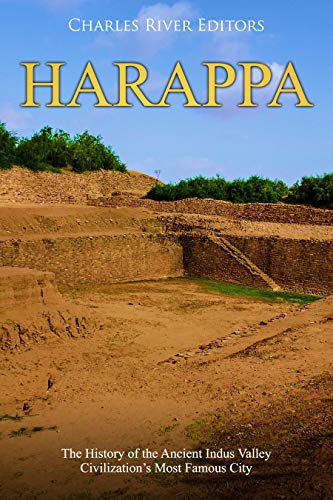
Significance of the ancient city of Harappa
- Rediscovery and Importance: Harappa is considered the “type site” of the Harappan Civilization because it was the first IVC site to be excavated, in 1921. Although its significance only became fully apparent after the discovery of Mohenjo-daro, the excavations at Harappa were crucial in recognizing the existence of a highly advanced, ancient civilization in the Indian subcontinent.
- Urban Planning and Architecture: Like other major Harappan cities, Harappa exhibited advanced urban planning with a grid system for streets and well-constructed brick houses. The city featured a fortified citadel on a raised area, likely serving as an administrative and religious center. Harappan architecture utilized standardized baked bricks, a significant technological advancement.
- Granaries and Sanitation: Harappa included large granaries for storing food supplies, suggesting administrative control over resources. The city also boasted an advanced sanitation system with covered drains and possibly even toilets in some homes.
- Crafts and Trade: Harappan culture is known for its craftsmanship, including seals with distinctive Indus script and animal motifs, terracotta pottery, and elaborate jewelry made from various materials like gold, stone, and shell. The civilization engaged in extensive trade networks, both internally within the region and with distant lands like Mesopotamia.
- Social and Economic Aspects: The presence of organized cemeteries with varied burial practices at Harappa suggests social and economic differentiation within the society. The standardized weights and measures found throughout the IVC, first recognized at Harappa, indicate a developed economic system.
- Potential for Further Discoveries: Despite significant excavation, much of the ancient city of Harappa remains unexplored, offering the possibility of further discoveries that could shed more light on this fascinating civilization.
In essence, the ancient city of Harappa serves as a crucial window into the Indus Valley Civilization, showcasing its urban planning, technological advancements, social structures, economic practices, and artistic expressions. It remains a testament to a flourishing civilization that predates many known ancient cultures, and its study continues to reveal more about the early history of South Asia.
Mohenjo-Daro
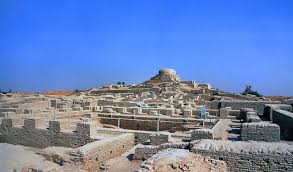
Mohenjo Daro
Mohenjo-Daro, meaning “Mound of the Dead Men” in Sindhi, was one of the largest and most well-preserved cities of the ancient Indus Valley Civilization (IVC). built around 2500 BCE, it’s located in the Larkana District of Sindh province, Pakistan, on the right bank of the Indus River.
1. Discovery and history
- Early Investigations: The site remained undocumented for around 3,700 years until R. D. Banerji of the Archaeological Survey of India visited the site in 1919–20.
- Large-Scale Excavations: Following Banerji’s findings, major excavations were undertaken by K. N. Dikshit and John Marshall in the 1920s, Wikipedia says and by others in subsequent decades.
- UNESCO World Heritage Site: Mohenjo-Daro was recognized as a UNESCO World Heritage site in 1980.
2. Urban planning and architecture
- Planned City Layout: Mohenjo-Daro is renowned for its remarkable urban planning, featuring a grid layout with streets and lanes intersecting at right angles. Most buildings were constructed with fired bricks, with some incorporating mud bricks and wooden elements.
- The Citadel and Lower City: The city was divided into two main parts:
- The Citadel: A raised mound, about 12 meters high, likely serving as the administrative and ceremonial hub. It housed public baths, assembly halls, and a large residential structure that could accommodate thousands.
- The Lower City: The residential area with courtyard houses, indicating a considerable middle class.
- Advanced Sanitation System: Mohenjo-Daro boasted one of the most sophisticated sanitation systems in the ancient world., houses had private bathrooms and toilets, connected to an extensive network of covered drains running along the streets. These drains featured manholes for inspection and maintenance. The importance given to hygiene is evident in this advanced system, unparalleled in many ancient civilizations.
- Notable structures
- The Great Bath
: A large, rectangular tank, likely used for ritual bathing, possibly for purification and renewal. It was lined with fine, waterproof baked bricks and may have been filled with water from a nearby well.
- Granary
: A massive granary, suggesting advanced storage technology and administrative control over agricultural produce.
- College of Priests
: A large building near the Great Bath, tentatively identified as a residential structure potentially for priests.
- Artifacts and crafts
- Seals: Numerous seals, carved from steatite, depict animals (both real and mythical, like the “unicorn” seal), human-like figures, and Indus script. The purpose of the seals is debated, but they likely played a role in administration and trade.
- Figurines and Sculptures: Discoveries include terracotta figurines of the Mother Goddess, animals, and the iconic “Dancing Girl” bronze statue which highlights the artistic abilities of the IVC people.
- Pottery and Jewelry: A variety of pottery styles have been found, as well as jewelry and ornaments made from gold, precious stones, terracotta, and shell.
- Decline
- Unknown Causes: The reasons for Mohenjo-Daro’s decline around 1900 BCE, along with other IVC cities, remain a mystery.
- Multiple Theories: Possible factors include tectonic activity, which may have shifted river courses and caused floods;t climate change, such as shifts in monsoon patterns or deforestation; and possibly even invasions.
Mohenjo-Daro stands as a testament to the ingenuity and advancements of the Indus Valley Civilization, with its meticulously planned urban environment, sophisticated infrastructure, and rich artistic heritage. Despite the many secrets it still holds, ongoing research continues to uncover new details about this remarkable ancient city.
The name Mohenjo-Daro is a modern designation given to the ancient city by archaeologists, and it translates from Sindhi as the “Mound of the Dead Men” or the “Mound of Mohan”. This name was inspired by the numerous mounds of ruins and skeletal remains found at the site during excavations in the 1920s.
Why the name “Mound of the Dead Men”?
- Archaeological Discovery: When archaeologists began excavating the site, they uncovered the remains of a once-thriving urban center buried under layers of earth.
- Skeletal Remains: The discovery of human bones and skeletal remains within these mounds led to the modern name, reflecting the remnants of the long-abandoned city and its inhabitants.
An ongoing mystery
It’s important to note that the original name of the city remains unknown, as the Indus script has not yet been deciphered. Therefore, “Mound of the Dead Men” is a descriptive name given in the context of its rediscovery. The layers of soil and debris that accumulated over millennia, along with the human remains found, undoubtedly contributed to this evocative name for one of the most remarkable archaeological sites of the Indus Valley Civilization.
What happened to them?
The decline of the Indus Valley Civilization (IVC), or Harappan Civilization, is a complex and debated topic. However, research suggests that it was not a sudden disappearance but rather a gradual process of de-urbanization and cultural transformation, marked by migration and the emergence of smaller, regional cultures.
Here’s a breakdown of what happened and the most plausible theories:
1. Decline of urban centers and migration
- Gradual Decline: The IVC, which flourished between 2600 and 1900 BCE, showed signs of decline starting around 1900 BCE. The great cities like Mohenjo-Daro and Harappa saw a deterioration in urban planning, with evidence of overcrowding, encroachment on streets and courtyards, and the disuse of public structures like the Great Bath.
- Shift in Population: Many IVC inhabitants migrated eastward and southward, leading to a significant increase in the number of settlements in areas like Gujarat, East Punjab, Haryana, and upper Doab, while the number of settlements declined in the core regions like the Ghaggar-Hakra valley.
- Emergence of Late Harappan Cultures: This migration led to the development of localized cultures in the Late Harappan phase, each with its own distinct identity. These cultures, like the MAP Academy Jhukar culture in Sindh and the Cemetery-H culture in Punjab, exhibited both continuity with Harappan traditions and the emergence of new cultural traits.
- Theories for the decline
- Climate Change: This is now considered the most likely primary factor, a significant shift in monsoon patterns around 1800 BCE led to a cooler and drier climate, impacting agriculture and water availability for the IVC’s flood-dependent system. suggests that a weakening of the Indian summer monsoon was particularly detrimental.
- Shifting River Courses: The drying up of the Saraswati River, or changes in the course of the Indus and other rivers due to tectonic activity, may have also played a role in the decline of specific cities and regions.
- Decline in Trade: The cessation or reduction of trade with Mesopotamia, which faced its own political and economic problems around this time, likely impacted the IVC’s economy.
- Not Invasion: The once-popular Aryan invasion theory, suggesting a violent conquest by an Indo-European tribe, has been largely debunked due to a lack of archaeological evidence and the finding that the civilization’s decline was more gradual.
- Transformation and legacy
- Not a Sudden End: Rather than a complete collapse, the IVC underwent a process of transformation, where its inhabitants adapted to changing environmental conditions and reorganized into smaller, agricultural communities.
- Cultural Legacy: Elements of the Indus Valley Civilization persisted and influenced later cultures in the Indian subcontinent. This includes craft traditions, possible religious beliefs like the worship of a mother goddess and Pasupati, and aspects of domestic life like town planning and sanitation practices.
- Shift to Ganges Valley: As the Indus region became less hospitable, many former inhabitants migrated towards the Ganges basin, contributing to the development of later cultures in the region.
In conclusion, the people of the Indus Valley Civilization adapted to the changing environment by migrating and establishing new communities, leading to the gradual decline of the great cities and the emergence of new, regional cultures.