
The Rise Of Quantum Computing
The rise of quantum computing promises to revolutionize computation by harnessing the principles of quantum mechanics to solve problems that are currently impossible for even the most powerful classical supercomputers. While still in its early stages, this technology is rapidly advancing, with potential applications across pharmaceuticals, finance, AI, and cybersecurity.
How quantum computing works
Unlike traditional computers that use binary bits (0s or 1s), quantum computers use quantum bits, or qubits, which leverage quantum phenomena to perform calculations in fundamentally different ways.
Superposition:
A qubit can exist in a state of 0, 1, or a combination of both simultaneously. This allows a quantum computer to process a vast number of possibilities in parallel, providing a significant computational speed-up for certain problems.
Entanglement:

This phenomenon links qubits in such a way that the state of one is instantly correlated with the state of others, regardless of the physical distance between them. This “spooky action at a distance” enables powerful new computational capabilities.
Quantum algorithms:
These are specifically designed to exploit superposition and entanglement. Notable examples include Shor’s algorithm, which can factor large numbers exponentially faster than classical computers, and Grover’s algorithm for accelerating database searches.
Potential applications and impact
Drug discovery and materials science:

Quantum computers can accurately simulate molecular interactions at the atomic level, which is currently impossible for classical computers. This could drastically accelerate the development of new drugs and the creation of innovative materials.
Financial modeling and optimization:
Complex financial systems, risk assessment, and portfolio optimization can be modeled as quantum processes, potentially leading to faster and more accurate analysis for banks and investment firms.
Artificial intelligence:
Combining quantum computing with machine learning could lead to vastly more powerful AI. Quantum computers may be better at recognizing patterns in massive datasets and generating more realistic training data for AI models.
Cybersecurity and cryptography:
While posing a threat to current encryption methods like RSA (which Shor’s algorithm could break), quantum computing also enables new, highly secure communication methods like Quantum Key Distribution (QKD) and drives the development of post-quantum cryptography (PQC).
Climate modeling and sustainability:
The technology could help build more accurate climate models, optimize complex logistics and traffic flows, and develop more efficient processes for sustainable energy, such as clean hydrogen production.
Current state and challenges
Quantum supremacy vs. quantum advantage:
In 2019, Google claimed to achieve “quantum supremacy” by solving a specific, contrived problem faster than a classical supercomputer. However, the more important goal is demonstrating quantum advantage, where a quantum computer provides a significant, practical benefit in a real-world application that is impossible or prohibitively slow for classical computers.
Hardware limitations:
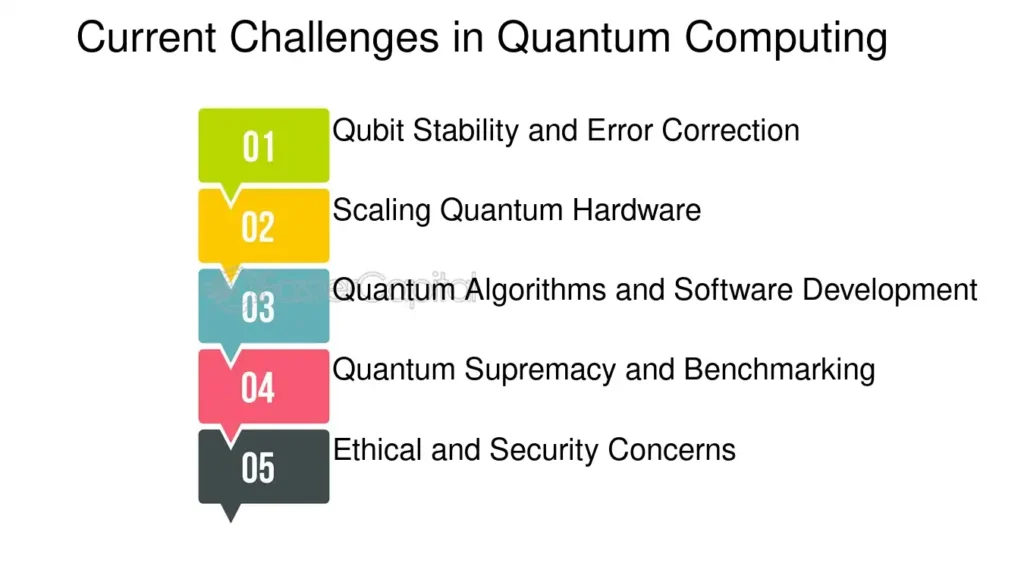
Qubits are extremely fragile and susceptible to decoherence, the loss of their quantum state due to environmental interference like temperature fluctuations. Building and scaling systems with high-quality, stable qubits and effective error correction mechanisms is a major challenge.
Scaling and error correction:
Current quantum computers have a limited number of qubits and suffer from high error rates. Achieving fault-tolerant quantum computing, which requires robust error correction, is crucial for tackling real-world problems and will require thousands or even millions of qubits working together.
High costs and talent gaps:
The infrastructure needed for quantum computing is prohibitively expensive, limiting access to large corporations and government-funded labs. There is also a severe shortage of professionals with the specialized skills needed to develop quantum algorithms and software.
Future outlook of Quantum Computing

The future of quantum computing is expected to be a hybrid model, where specialized quantum systems work in tandem with classical supercomputers to solve specific, difficult problems. As research continues and hardware becomes more stable, a focus on practical applications and the development of a skilled workforce will accelerate the transition toward achieving reliable quantum advantage. Companies and governments worldwide are heavily investing in this technology, anticipating its potential to create new industries and reshape scientific and economic landscapes in the coming decades.
Hardware and software maturation
- Focus on logical qubits and error correction: The primary focus will shift from simply increasing the number of physical qubits to creating stable, fault-tolerant logical qubits through advanced quantum error correction.
- This is critical for reliable computations, as current physical qubits are fragile and prone to decoherence from environmental noise.
- IBM has a roadmap to achieve a quantum system with 200 logical qubits by 2029, while Microsoft and others are developing new error correction techniques.
A “quantum zoo” of technologies:
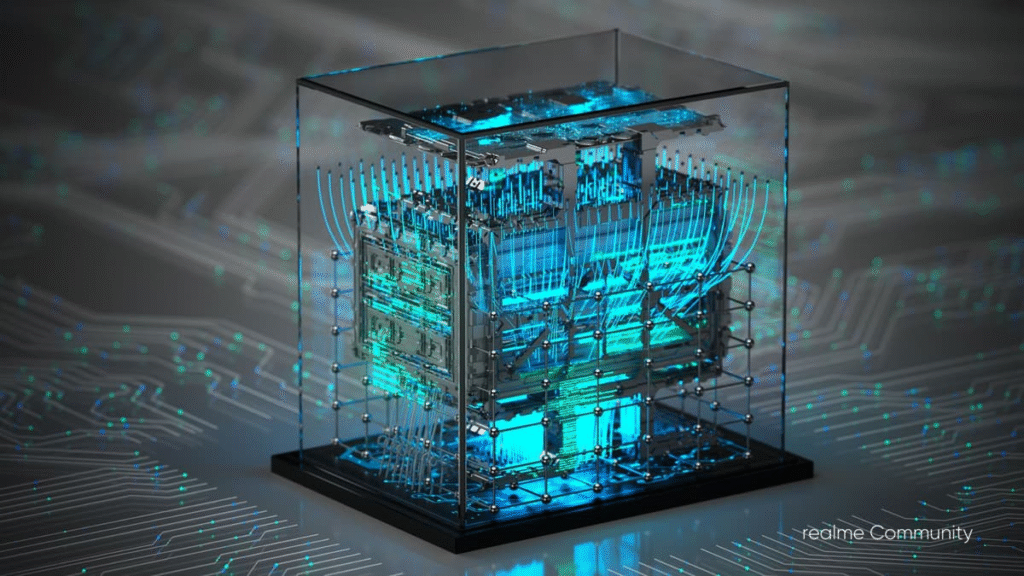
The industry will continue to explore and invest in various qubit modalities, such as superconducting, trapped ions, photonic, and neutral atoms, as each has unique strengths.
The rise of the quantum software industry:
As hardware matures, there will be a corresponding growth in the software ecosystem, including tools, algorithms, and application-specific programs designed to run on quantum hardware.
Hybrid and distributed computing models
Quantum-classical hybrid systems:
The most likely path to achieving early practical quantum advantage is a hybrid model where specialized quantum processors (QPUs) work in tandem with classical supercomputers.
Classical systems can handle tasks like data preparation and post-processing, while QPUs tackle the computationally intractable parts of a problem.
Cloud-based platforms like Microsoft Azure Quantum and Amazon Braket are already developing architectures that tightly couple these systems for integrated workflows.
Distributed quantum computing and networks:
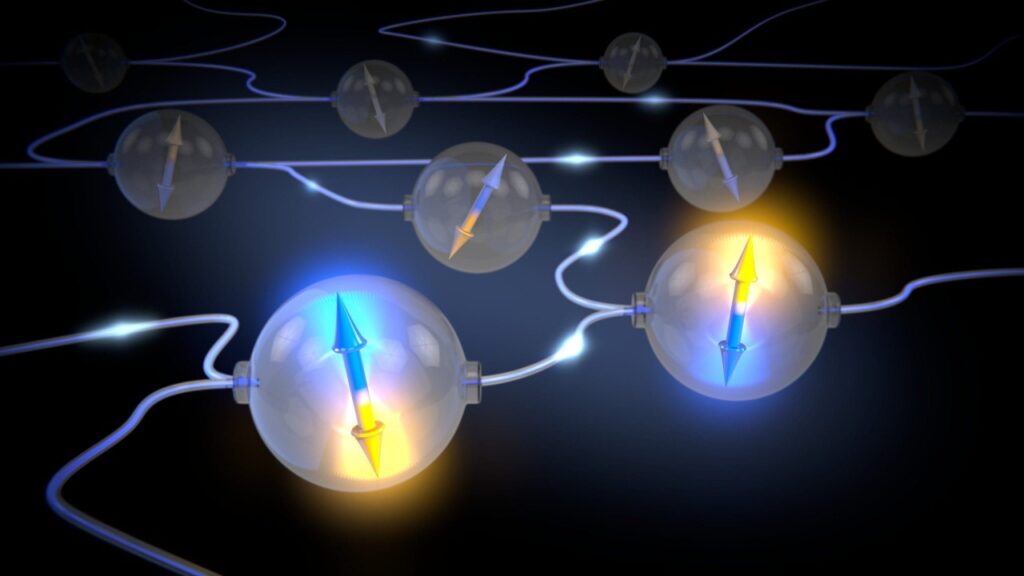
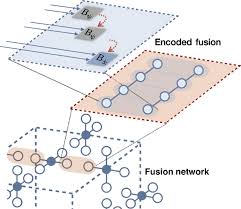
Research is underway to connect multiple quantum processors over quantum networks, similar to how classical supercomputers are built today.
This modular approach could overcome the physical limitations of building a single, monolithic quantum computer and enable powerful, wide-area quantum networks.
The looming cybersecurity threat and response
The post-quantum cryptography (PQC) race:
The threat that powerful quantum computers could break today’s standard encryption (like RSA) is driving a global effort to develop and adopt PQC algorithms that can withstand both classical and quantum attacks.

Governments and tech companies are beginning to implement NIST-approved PQC algorithms and transition to quantum-safe frameworks to prevent “Harvest Now, Decrypt Later” attacks.
Quantum Key Distribution (QKD):
Researchers are also advancing quantum-based communication technologies like QKD, which uses quantum mechanics to create un-hackable encryption keys and ensure highly secure communication networks.
Workforce development and investment
Growing skills gap:
As the field advances, there is a significant and growing demand for a specialized workforce with expertise spanning quantum physics, computer science, and engineering.Addressing this talent shortage will require more educational programs, industry-academia partnerships, and upskilling initiatives.
Continued public and private investment:
Despite some market volatility, global investment from both governments and venture capital is strong, indicating a long-term commitment to the field and pushing the timeline for practical quantum advantage closer to the end of the decade.