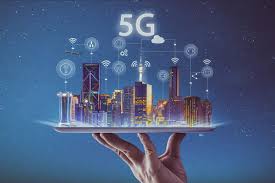
The Rise of 5G Technology and Its Global Impact
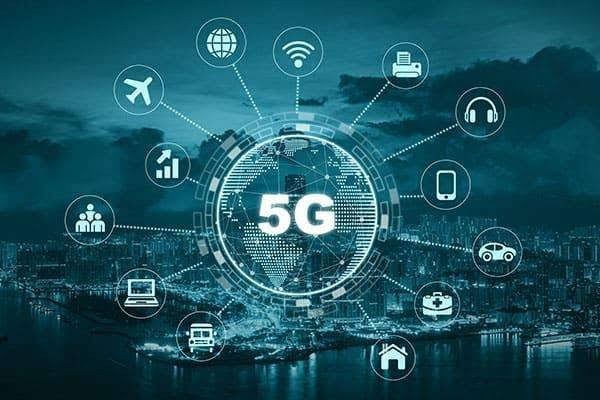
Introduction to the Rise of 5G
5G technology, the fifth generation of wireless networks, emerged commercially around 2019 and has since experienced unprecedented global adoption. By mid-2025, it has surpassed 2.25 billion connections worldwide, marking it as the fastest-deployed mobile technology in history—four times quicker than 4G. Forecasts indicate that by the end of 2025, subscriptions could reach 2.9 billion, covering over two in five people globally. This rapid rollout is fueled by advancements in speed (up to 20 Gbps), ultra-low latency (under 1 ms), massive device connectivity, and enhanced reliability, enabling transformative applications across industries. However, its full potential—beyond consumer speeds—lies in industrial automation, standalone networks, and integration with emerging tech like edge computing.
Global Deployment and Adoption
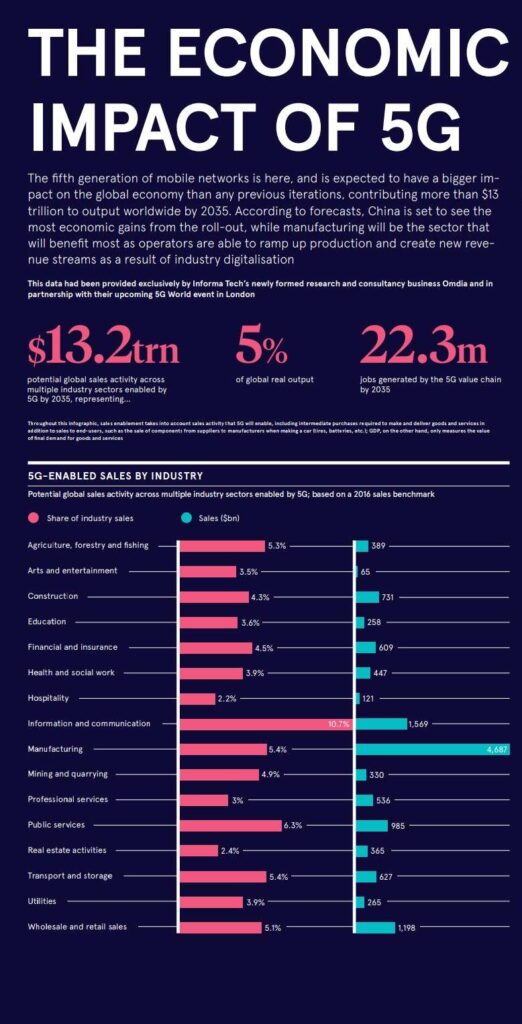
The rise of 5G has been uneven but accelerating. As of 2025, global coverage stands at around 53%, with leading regions like China far outpacing others in infrastructure and connectivity. In the U.S. and Europe, adoption is strong in urban areas, but rural gaps persist, prompting innovations like 5G fixed wireless access (FWA) for broader reach. Emerging markets in Asia and Africa are leveraging 5G for leapfrog development, with investments driving patent activity and market growth. By 2035, 5G’s economic ripple effects are projected to contribute trillions to global GDP, reshaping enterprises and unlocking new value in sectors like manufacturing and entertainment.
Impacts on Key Sectors
5G’s global impact extends far beyond faster downloads, revolutionizing industries through real-time data sharing and massive connectivity. In healthcare, it enables remote surgeries, real-time diagnostics, and telemedicine, potentially saving lives in underserved areas. Transportation benefits from autonomous vehicles and connected infrastructure, reducing accidents and improving efficiency. Smart cities leverage 5G for IoT-driven traffic management, energy optimization, and public safety. In manufacturing, industrial automation and robotics boost productivity, with examples like 5G-powered mines and hospitals demonstrating economic gains. Entertainment and education see enhancements via AR/VR and immersive learning, while agriculture uses precision farming for better yields. Overall, 5G is projected to add $2.2 trillion to the global economy by 2025, fostering innovation and job creation.
Challenges and Concerns
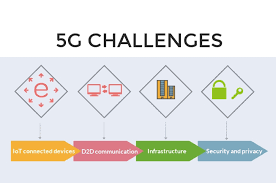
Despite its promise, 5G faces hurdles. Uneven global rollout exacerbates the digital divide, with high costs and infrastructure needs hindering adoption in rural or developing regions. Security risks, including cybersecurity vulnerabilities and potential for increased surveillance, are prominent concerns. Environmental impacts from expanded networks, such as energy consumption, also draw scrutiny. Health-related debates persist, with some experts warning about electromagnetic radiation from millimeter waves potentially affecting the heart, nervous system, DNA, and causing oxidative stress, anxiety, or chronic diseases—though scientific consensus remains divided. Geopolitically, competitions like the U.S.-China race highlight risks of technological fragmentation. As 6G prototypes emerge, addressing these through balance regulation and research is crucial.
connectivity of 5G
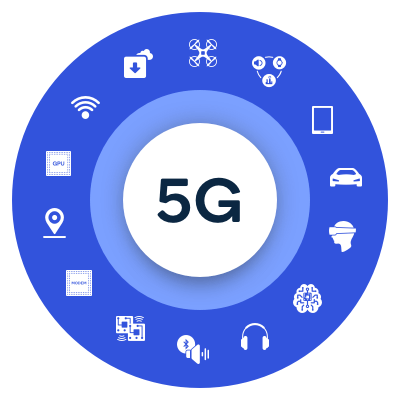
5G connectivity is defined by its ability to deliver ultra-fast speeds, ultra-low latency, and massive network capacity by using a flexible architecture that combines multiple radio frequency bands with advanced software-driven technologies.
Key features
- Ultra-fast speeds 5G networks are designed to offer peak download speeds of up to 20 Gbps, which is significantly faster than 4G, enabling near-instant downloads of large files and seamless 4K/8K video streaming.
- Ultra-low latency Latency, the delay in data transmission, is reduced to as low as 1 millisecond. This near-real-time responsiveness is critical for mission-critical applications like remote surgery, autonomous vehicles, and online gaming.
- Massive network capacity 5G can connect millions of devices per square kilometer simultaneously, far exceeding 4G’s capabilities. This is essential for the growth of the Internet of Things (IoT) in smart cities, homes, and industrial settings.
- Network slicing This key architectural feature allows network operators to create multiple virtual networks on a single physical infrastructure. Each “slice” can be customized with specific speed, latency, and capacity requirements for different applications, such as a high-reliability slice for public safety or a high-throughput slice for video streaming.
How it works
5G networks achieve their advanced capabilities by using a combination of different radio spectrums and cutting-edge technologies:
- Frequency bands 5G utilizes a layered spectrum to balance speed, range, and capacity:
- Low-band (Sub-1 GHz) provides broad, nationwide coverage, particularly in rural areas, and can penetrate buildings well. Speeds are faster than 4G but not at the highest 5G levels.
- Mid-band (1–6 GHz) offers a sweet spot between speed and coverage, providing high capacity in urban and suburban areas. This is the most widely deployed type of 5G today.
- High-band (mmWave) uses millimeter-wave frequencies (24+ GHz) for ultra-fast speeds and massive capacity in densely populated “hotspots” like stadiums or city blocks. Its signals have a short range and are easily blocked by obstacles.
- Advanced antenna technology 5G uses Massive MIMO (Multiple-Input, Multiple-Output) antenna arrays with hundreds of elements to send and receive more data simultaneously. Beamforming then directs focused radio signals precisely toward user devices, reducing interference and boosting performance.
- Edge computing By placing computing servers closer to the network’s edge, data can be processed near the end-user rather than in a distant data center. This greatly reduces latency and supports real-time applications more effectively.
- 5G core architecture The network’s core uses a service-based architecture (SBA) that leverages cloud-native technologies to be more agile, flexible, and scalable than previous generations.
Benefits and applications of 5G
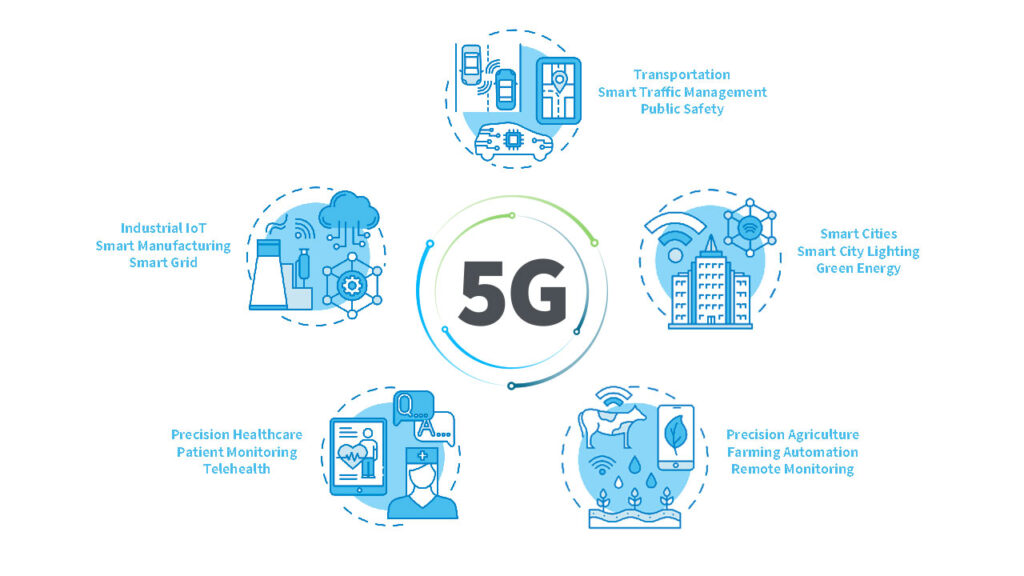
5G connectivity is the foundation for a wide range of transformative applications across various industries:
- Enhanced mobile broadband (eMBB) Delivers faster and more reliable connections for daily use, such as high-definition video streaming, augmented reality (AR), and virtual reality (VR) experiences.eMBB, or Enhanced Mobile Broadband, is one of the three primary use cases for 5G technology, focused on delivering significantly faster data speeds, higher capacity, and improved user experiences for data-intensive applications. It is essentially a natural evolution of 4G, designed to handle the increasing demand for mobile data and multimedia content.
- Smart cities and IoT Connects billions of sensors, cameras, and devices to manage traffic, optimize energy use, and improve public safety in real-time.Smart cities and the Internet of Things (IoT) are a paradigm that leverages connected devices to collect and analyze real-time data to improve urban services, enhance sustainability, and elevate residents’ quality of life. IoT sensors, cameras, and devices act as a city’s central nervous system, providing data that enables automation, efficiency, and data-driven decision-making across various sectors.
- Industrial automation and private networks The low latency and high reliability of 5G enable advanced automation, robotics, and predictive maintenance in manufacturing and logistics, often using dedicated private 5G networks.Industrial automation is being revolutionized by the deployment of private networks, particularly private 5G, which provides the dedicated, secure, and high-performance connectivity required for modern smart factories and other large-scale industrial sites. These custom-built networks serve as the backbone for advanced technologies like robotics, Industrial IoT (IIoT), and AI, enabling real-time operations, greater flexibility, and enhanced efficiency.
- Healthcare innovation Supports telemedicine with ultra-high-definition video consultations, remote patient monitoring via connected devices, and potentially even remote surgery.Healthcare innovation involves using technology to improve patient care, enhance diagnostics, and streamline operations. Technologies like AI, 5G, IoT, and robotics are transforming the healthcare landscape, driving advancements from telemedicine and personalized medicine to automated surgical and administrative procedures.
- Autonomous vehicles
Ultra-reliable and low-latency communications (URLLC)
The near-instant responsiveness of 5G is critical for time-sensitive, mission-critical applications that require ultra-high reliability and minimal delay.
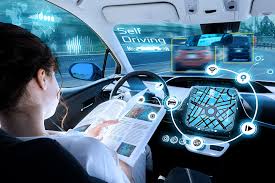
- Autonomous vehicles: Enables vehicles to communicate with each other, with traffic infrastructure, and with cloud services in real-time, which is essential for navigation, accident avoidance, and efficient traffic flow.
- Remote surgery and telemedicine: Allows specialists to perform complex procedures using robotic arms from a different location with no perceptible lag. It also supports real-time monitoring of patients and facilitates remote consultations.
- Industrial automation and robotics: Provides the reliable, low-latency connectivity needed for real-time control of robots, automated guided vehicles (AGVs), and smart assembly lines in factories.
- Emergency services and public safety: Ensures that first responders have robust communication links, allowing for faster incident detection, AI-powered video analysis, and improved coordination in critical situations.
Massive machine-type communications (mMTC)
Smart cities: Connects a vast network of sensors and devices to monitor traffic, manage energy grids, control smart streetlights, manage waste collection, and monitor environmental conditions.
Predictive maintenance: Industrial IoT (IIoT) sensors on machinery collect data on performance and health, allowing AI algorithms to predict equipment failures and trigger maintenance requests before costly downtime occurs.
Smart agriculture: Farmers use 5G-connected sensors and drones to monitor soil conditions, crop health, and livestock in real-time, enabling more efficient resource management and higher yields.
Logistics and asset tracking: Enables the real-time tracking of assets, inventory, and vehicle fleets, which optimizes supply chain operations and improves overall efficiency and accuracy.