
The Legacy of Mahatma Gandhi
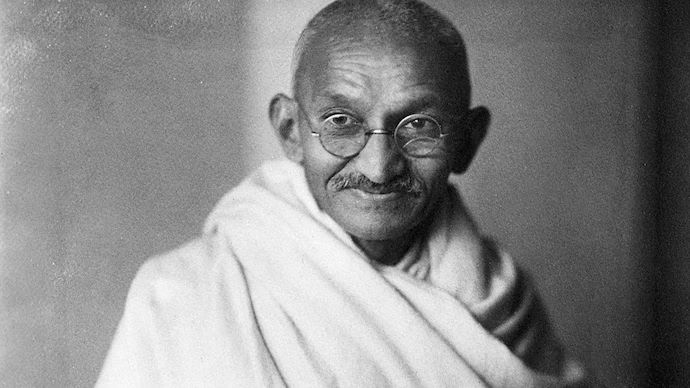
Mahatma Gandhi, born Mohandas Karamchand Gandhi on October 2, 1869, in Porbandar, India, emerged as a pivotal figure in the 20th century, embodying the principles of non-violence, truth, and civil disobedience. Often revered as the “Father of the Nation” in India, Gandhi’s life was dedicated to challenging injustice through peaceful means, a philosophy he termed “Satyagraha” or “truth force.” His experiences in South Africa, where he faced racial discrimination, honed his methods of non-violent resistance, which he later applied to India’s struggle against British colonial rule. Gandhi’s assassination on January 30, 1948, by a Hindu nationalist marked the end of an era, but his ideas transcended his lifetime, influencing global leaders, thinkers, and movements for freedom, civil rights, and social justice. This essay delves into Gandhi’s enduring legacy and examines how his principles inspired freedom movements across the world, fostering a paradigm shift toward non-violent activism.
Gandhi’s Legacy in India and the Foundations of His Philosophy
Gandhi’s legacy is most profoundly etched in India’s path to independence. Assuming leadership of the Indian National Congress in 1921, he orchestrated nationwide campaigns that addressed not only political freedom but also social issues like poverty alleviation, women’s rights, religious harmony, and the abolition of untouchability. His strategies included boycotts of British goods, the Salt March of 1930—where he defied colonial salt taxes by marching 240 miles to the sea—and the Quit India Movement of 1942, which demanded an end to British rule. These actions mobilized millions, demonstrating the power of collective non-violent protest to dismantle imperial control. By 1947, India achieved independence, though partitioned into India and Pakistan, an outcome Gandhi mourned due to the ensuing communal violence.
At the core of Gandhi’s philosophy was Ahimsa (non-violence), rooted in Hindu, Jain, and Buddhist traditions, coupled with Satyagraha, which emphasized passive resistance and moral persuasion over physical force. He believed that true change stemmed from self-purification and addressing internal flaws rather than external enemies, as he stated that it was not British arms but Indians’ own imperfections that sustained bondage. Gandhi’s emphasis on simplicity, self-reliance (through initiatives like spinning khadi cloth), and ethical living extended beyond politics, promoting a vision of “Positive Peace” where harmony prevails through justice and mutual respect. His legacy in India includes the establishment of democratic institutions, social reforms, and a cultural ethos of tolerance, though challenges like ongoing communal tensions highlight the unfinished nature of his work.
His influence permeated international discourse, with the United Nations recognizing his birthday as the International Day of Non-Violence in 2007. Gandhi’s writings, such as Hind Swaraj (Indian Home Rule) and his autobiography The Story of My Experiments with Truth, became blueprints for activists worldwide, underscoring that leadership rooted in humility and integrity could inspire mass movements.
Inspiration on Freedom Movements in the Americas
Gandhi’s principles profoundly shaped freedom and civil rights movements in the Americas, particularly in the United States. Martin Luther King Jr., a key leader in the American Civil Rights Movement, drew heavily from Gandhi’s tactics of non-violent resistance. King visited India in 1959, returning committed to Satyagraha, which he integrated into strategies like the Montgomery Bus Boycott (1955–1956) and the March on Washington (1963). He famously remarked, “Christ gave us the goals and Mahatma Gandhi the tactics,” highlighting how Gandhi’s methods provided practical tools for combating racial segregation and discrimination. This influence extended to other figures like James Farmer, who applied Gandhian non-violence in the Freedom Rides to desegregate interstate buses.
Anti-Colonial and Freedom Struggles in Africa and Asia
In Africa, Gandhi’s time in South Africa (1893–1914), where he developed Satyagraha against apartheid-like laws, laid the groundwork for his global impact. Nelson Mandela, the anti-apartheid icon and South Africa’s first post-apartheid president, credited Gandhi for shaping the African National Congress’s strategies. Mandela noted that Gandhi’s non-violent protests in South Africa inspired the Defiance Campaign of 1952 and the broader struggle against racial oppression, leading to apartheid’s end in 1994. Similarly, Kwame Nkrumah, Ghana’s independence leader, and Julius Nyerere of Tanzania drew from Gandhian self-reliance and non-violence in their decolonization efforts, accelerating Africa’s “wind of change” in the 1950s and 1960s.
Gandhi’s teachings during her house arrest, advocating peaceful resistance against military rule and earning the Nobel Peace Prize in 1991. In Tibet, the Dalai Lama has cited Gandhi as a role model, applying non-violence in the struggle for Tibetan autonomy from China. These instances show how Gandhi’s ideas ignited independence movements across colonized regions, bolstering existing struggles and sparking new ones.
Lesson from Gandhi Life
Gandhi’s influence extended to diverse leaders and thinkers, as evidenced by a compilation of 20 prominent figures inspired by him. For instance, Albert Einstein praised Gandhi’s enlightenment, while John Lennon incorporated his peace advocacy into anti-war protests. Political figures like Barack Obama and Al Gore drew from his non-violence in addressing global challenges, from diplomacy to climate action. In Europe, movements like Poland’s Solidarity in the 1980s echoed Gandhian non-cooperation against communist rule.
Mahatma Gandhi’s legacy is a testament to the transformative power of non-violence, reshaping India’s destiny and inspiring freedom movements worldwide. From civil rights in America to anti-colonial struggles in Africa and Asia, his philosophy empowered the oppressed to challenge tyranny through moral force rather than arms. Though criticisms exist—regarding his views on caste or partition—his enduring impact on global peace and justice is undeniable. In a world grappling with conflict, Gandhi’s message reminds us that true leadership lies in integrity and compassion, ensuring his spirit lives on in every quest for freedom.