
The History of the Renaissance in Europe
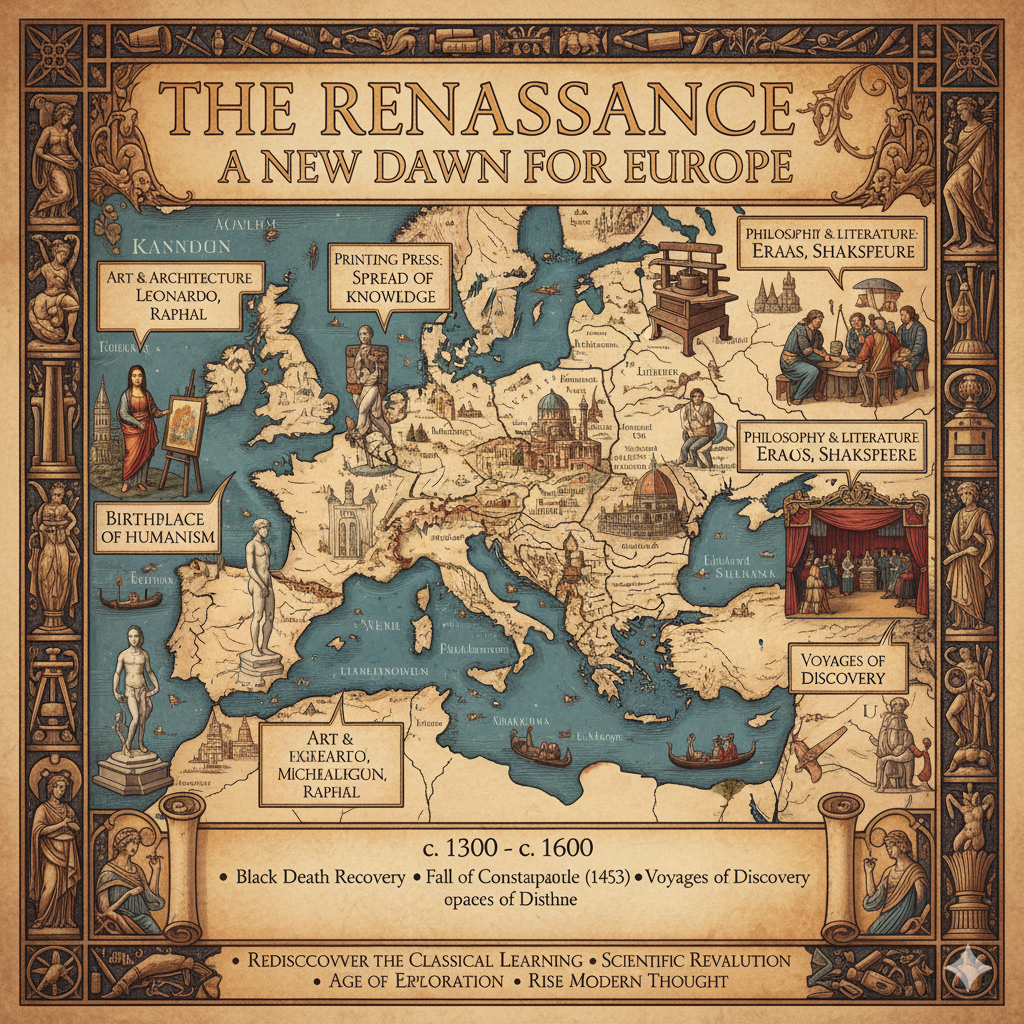
The Renaissance, meaning “rebirth” in French, was a transformative period in European history that marked the transition from the Middle Ages to modernity. It emphasized a revival of classical learning from ancient Greece and Rome, humanism (focusing on human potential and achievements), and advancements in art, science, literature, and politics. Generally spanning from the 14th to the 17th centuries, it originated in Italy—particularly Florence—and spread across Europe, fostering cultural, intellectual, and economic renewal after the challenges of the Middle Ages, including the Black Death and feudal decline.
The Renaissance emerged in Italy during the late 13th and early 14th centuries, influenced by the economic prosperity of city-states like Florence, Venice, and Milan, which benefited from trade and banking. The fall of Constantinople in 1453 brought Greek scholars and classical texts to Italy, accelerating the revival of ancient knowledge. Humanism, pioneered by figures like Petrarch (who coined the concept of the “Dark Ages” for the Middle Ages) and Dante Alighieri, shifted focus from medieval scholasticism to individual dignity, secular inquiry, and classical ideals. The Black Death (1347–1351) disrupted society but spurred a reevaluation of life, leading to increased patronage of the arts by wealthy families like the Medici. Other factors included the decline of the Roman Catholic Church’s dominance and the rise of national languages and monarchies.
Times
Early Renaissance c. 1300–1450
Originated in Italy; focus on realism in art, humanism, and architectural innovations like linear perspective. Overlapped with the Late Middle Ages; influenced by proto-Renaissance figures like Giotto.
High Renaissance. 1450–1520
Peak of artistic achievement in Italy (Florence and Rome); emphasis on harmony, proportion, and human anatomy; marked by grand works and patronage.
Late Renaissance. 1520–1600
Transition to Mannerism with more stylized, emotional art; spread widely across Europe; influenced by the Reformation and Counter-Reformation.
Major Players
Art: Leonardo da Vinci (e.g., “Mona Lisa,” scientific notebooks), Michelangelo (Sistine Chapel ceiling, “David”), Raphael (“The School of Athens”), Sandro Botticelli (“Birth of Venus”), Donatello (bronze sculptures), Titian (portraits), and Filippo Brunelleschi (Florence Cathedral dome).
Literature: Petrarch (sonnets, humanism), Dante Alighieri (“Divine Comedy”), Giovanni Boccaccio (“The Decameron”), Niccolo Machiavelli (“The Prince”), William Shakespeare (plays like “Romeo and Juliet”), and Geoffrey Chaucer (“The Canterbury Tales”).
Science: Nicolaus Copernicus (heliocentric theory), Galileo Galilei (telescopic discoveries), Leonardo da Vinci (anatomy and engineering studies), Tyco Brahe (astronomical observations), and Johannes Kepler (planetary laws).
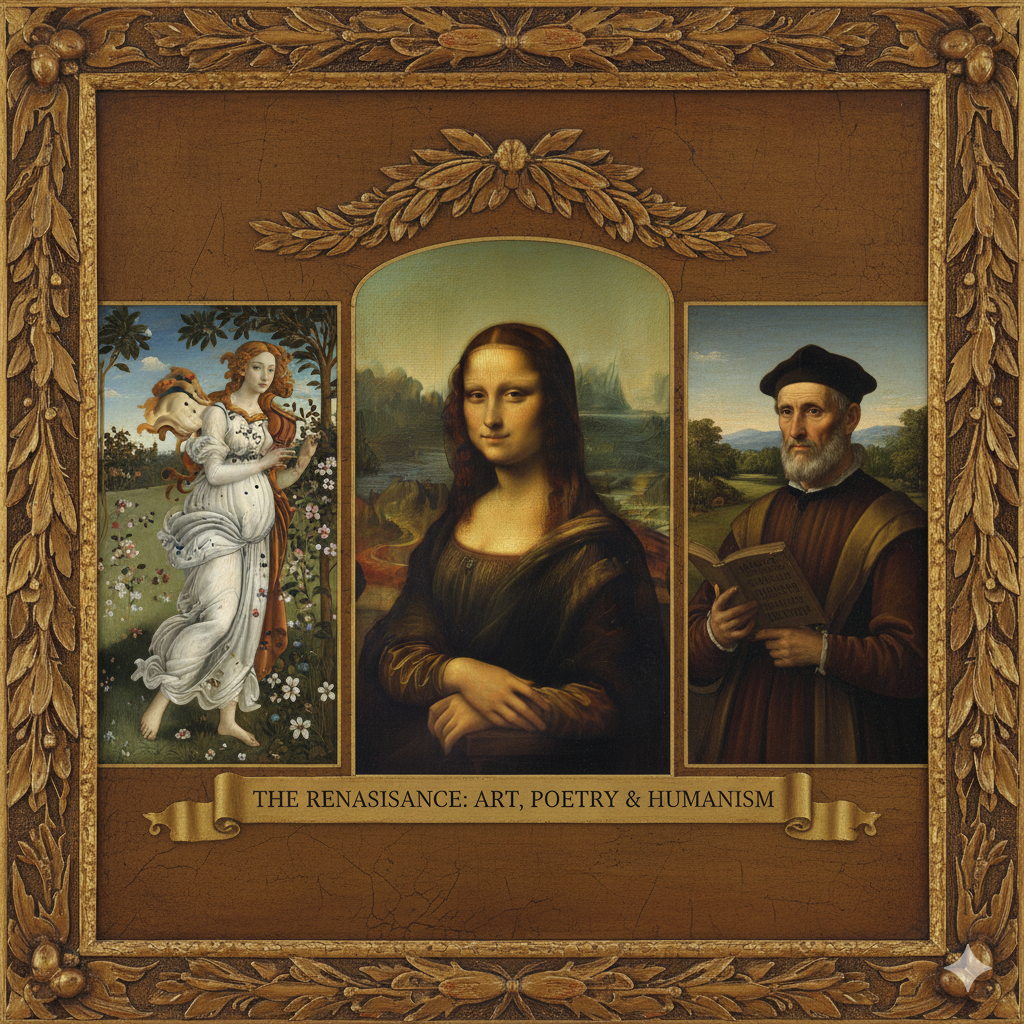
Major Conquests
Invention of the Printing Press (c. 1440): Johannes Gutenberg’s innovation spread ideas, texts, and literacy rapidly.
Fall of Constantinople (1453): Byzantine scholars fled to Italy, bringing Greek manuscripts.
Age of Discovery (late 15th–16th centuries): Explorers like Christopher Columbus (1492 voyages), Vasco da Gama, and Ferdinand Magellan expanded European horizons, challenging classical geography.
Protestant Reformation (1517 onward): Martin Luther’s 95 Theses, influenced by humanist criticism, split Christianity, leading to the Counter-Reformation and Council of Trent (1545–1563).
Black Death Recovery: Post-1348 economic shifts enabled urban growth and artistic investment.
Scatter to Northern Europe
France: Italian artists influenced royal courts; e.g., Château de Chambord architecture under Francis I.
Germany and Low Countries: Humanism linked to the Reformation; artists like Albrecht Dürer (engravings) and Pieter Bruegel (realistic peasant scenes); Erasmus epitomized Northern humanism.
Other Regions: Hungary under Matthias Corvinus (library and arts patronage); Poland’s Golden Age with Copernicus; Spain and Portugal tied to explorations.
England: Elizabethan era (late 16th century) with Shakespeare and Thomas More (“Utopia”).
Customs and Knowledge Development
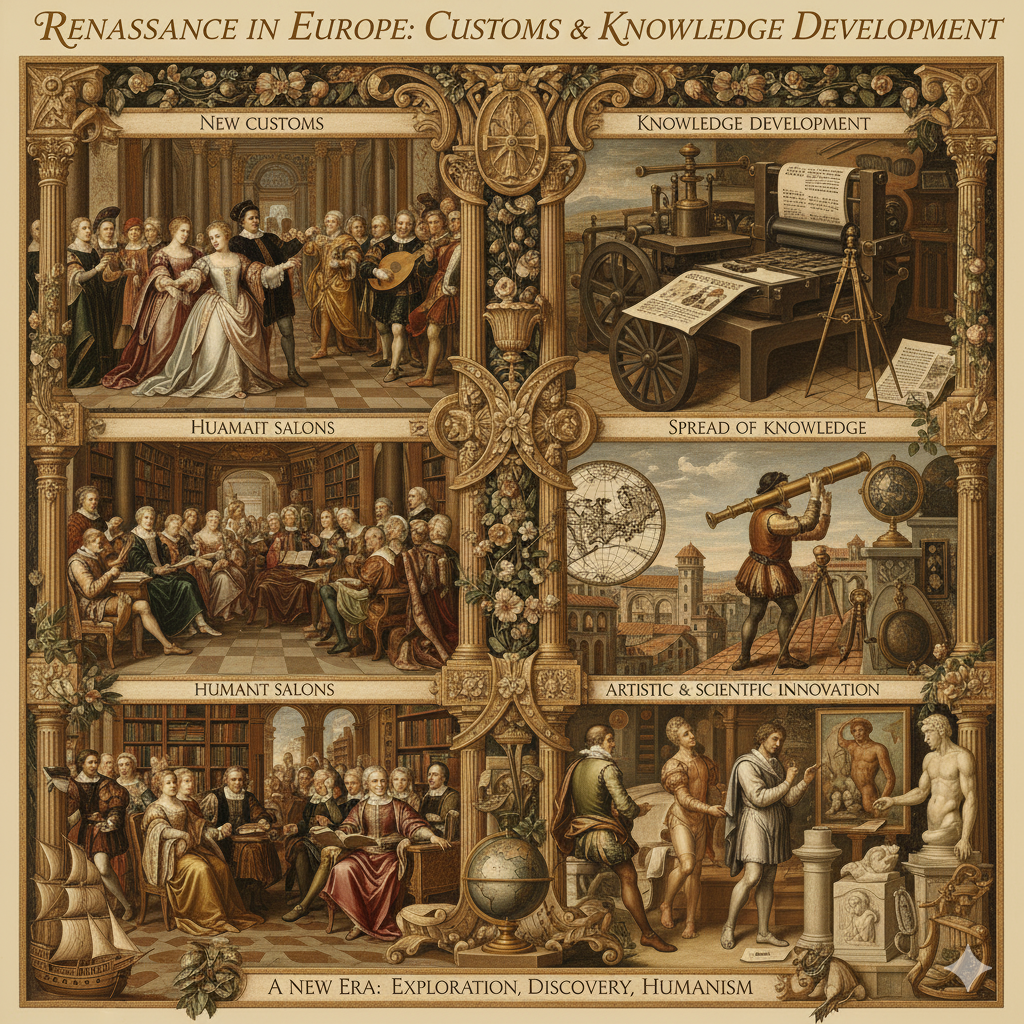
The Renaissance laid foundations for modern Western civilization, influencing the Enlightenment, Scientific Revolution, and Baroque period. It promoted individualism, secular inquiry, and artistic realism, impacting education, politics, and culture. Iconic works endure as symbols of human achievement, and its emphasis on exploration expanded global knowledge. However, it was elitist, benefiting urban elites while rural life changed little, and it overlapped with ongoing religious conflicts.
Humanism and Education: Emphasis on classical texts, vernacular languages, and individual potential; reformed universities and promoted empirical inquiry.
Art and Architecture: Innovations like linear perspective, realistic anatomy, and oil painting; buildings incorporated classical elements (columns, domes).
Science and Philosophy: Shift to observation and inductive reasoning; challenged Aristotelian views, paving the way for the Scientific Revolution.
Religion and Society: Humanist critiques fueled the Reformation; increased secularism, though many works remained religious.
Economy and Politics: Rise of banking (e.g., Medici), diplomacy, and republican ideas in city-states.