
The History of the Chinese Dynasties
The history of Chinese dynasties spans millennia, from the semi-legendary Xia dynasty to the final Qing dynasty in 1912. These eras are defined by the succession of ruling families, known as dynasties, and each contributed to the political, cultural, and technological foundations of modern China.
Xia Dynasty (~2070–1600 BCE)
The Xia dynasty (c. 2070–1600 BCE) holds a pivotal, though debated, place as the first hereditary dynasty in traditional Chinese history. While its existence was once considered legendary, archaeological findings have provided compelling evidence of a state-level society, prompting scholars to re-evaluate the Xia’s historicity.
Traditional narrative: These texts describe a line of 17 hereditary rulers descending from the dynasty’s founder, Yu the Great. They portray Yu as a heroic figure who tamed the Yellow River’s catastrophic floods, organized the land into provinces, and established dynastic rule.
Historical debate: Skeptical scholars in the early 20th century viewed these accounts as myths created by later dynasties, especially the Zhou, to legitimize their own rule by establishing a precedent of dynastic change based on a ruler’s virtue.
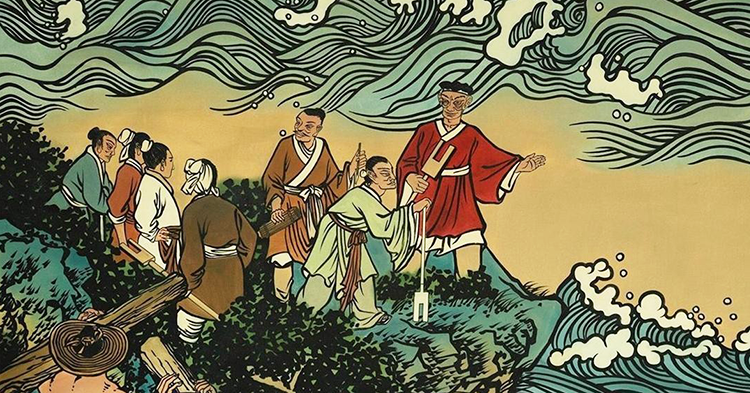
Flood evidence: Geological evidence of a catastrophic flood on the Yellow River around 1920 BCE has been cited as a possible historical basis for the flood myth associated with Yu the Great.
Continuing debate: Despite these findings, definitive proof remains elusive. No written records with the name “Xia” have been found at the Elliot site, leading to ongoing debate over whether the archaeological culture truly corresponds to the legendary dynasty. Hereditary rule: Yu the Great’s decision to pass power to his son, Qi, is presented as the beginning of the hereditary dynastic system that would govern China for millennia.
State formation: The archaeological evidence from the Erlitou culture suggests that a state-level society emerged in China earlier than previously thought, laying the foundation for the more historically certain Shang dynasty that would follow.
Shang Dynasty (~1600–1046 BCE)
The Shang dynasty (c. 1600–1046 BCE) was the first historically documented dynasty of China, confirming the existence of a state-level society following the legendary Xia dynasty. Centered in the Yellow River Valley, the Shang left a rich archaeological record of their achievements, particularly in metallurgy and writing.
Feudal system: The Shang kings maintained control over their large territory through a feudal system. They appointed nobles to govern regional areas, who in turn provided military service and collected resources for the central government.
Social hierarchy: Shang society was rigidly stratified. Below the royal family and aristocracy were the military, followed by artisans, craftsmen, and peasants. At the bottom of the social ladder were slaves, often captured prisoners of war.
Military technology: Shang military supremacy relied on advanced bronze weaponry and the use of horse-drawn chariots, which likely arrived in China from Central Asia. Chariots provided a significant tactical advantage in battles and were also used in royal hunts.
Calendar: Shang astronomers developed a lunar calendar to track and predict important events, particularly harvests. It required adjustments to maintain its accuracy with the solar year.
Zhou Dynasty (~1046–256 BCE)
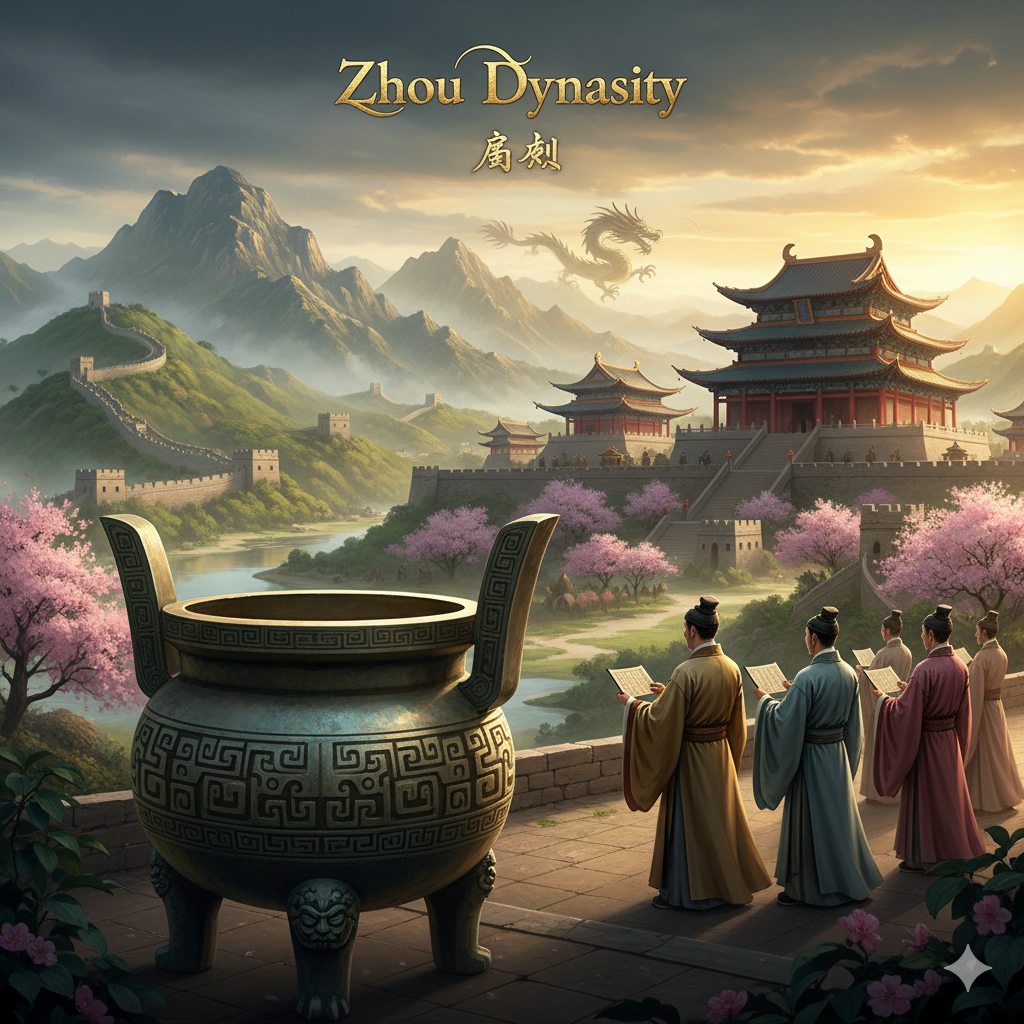
The Zhou dynasty (c. 1046–256 BCE) was the longest-lasting dynasty in Chinese history and one of the most culturally significant. It is best known for introducing the concept of the Mandate of Heaven, which provided a philosophical and political justification for imperial rule that would endure for millennia. The dynasty is divided into two major periods, reflecting a shift from a relatively unified feudal state to a fragmented landscape of warring powers.
Mandate of Heaven: To legitimize their conquest, the Zhou introduced the concept that Heaven (Tian) granted the right to rule to a virtuous and just emperor, the “Son of Heaven”. This mandate could be revoked if the ruler became tyrannical or unjust. Natural disasters and famine were often interpreted as signs that a dynasty had lost the mandate, justifying rebellion.
Eastern Zhou (770–256 BCE)
The Western Zhou’s power began to weaken as kinship ties thinned over generations and regional lords became more independent. The end came in 771 BCE, when the capital was sacked by invaders allied with a rebellious lord. The royal court fled east to Luoyang, marking the beginning of the Eastern Zhou, a period of intensified fragmentation. The Eastern Zhou is further divided into two sub-periods
Warring States Period (c. 475–221 BCE)
- Intensified warfare: As the Zhou’s authority completely collapsed, the most powerful states declared themselves kings and engaged in large-scale warfare to unify China.
- Military innovations: Warfare became more brutal and strategic, with the introduction of iron weapons, the crossbow, and mass infantry armies, replacing the old aristocratic chariot warfare.
- Fall of Zhou: The last vestiges of the Zhou royal house were extinguished in 256 BCE when they were conquered by the state of Qin, which would go on to unify China
Qin Dynasty (~221–206 BCE)
The Qin dynasty (221–206 BCE), though short-lived, was one of the most transformative periods in Chinese history. Led by the ruthless but visionary emperor Qin Shi Huang, the state of Qin ended the chaotic Warring States period and unified China for the first time, establishing the foundation for its subsequent imperial system.
Qin Shi Huang, the “First Emperor”: King Zheng of Qin proclaimed himself Qin Shi Huangdi, or “First Emperor,” a title symbolizing his unprecedented power. He abolished the feudal system of the Zhou dynasty, stripping the aristocracy of power and forcing noble families to move to the new capital, Xianyang.
Standardized systems: To overcome cultural and economic barriers, the Qin standardized currency, weights, and measures throughout the empire. Even the axle width of carts was standardized to fit the ruts of the new road system, improving efficiency for trade and military transport.
Unified writing: Prime Minister Li Si oversaw the standardization of the Chinese writing system, known as the “small seal script.” This creation of a uniform script was a major cultural achievement that allowed for communication across different dialects and unified Chinese culture for millennia.
Roads and canals: The dynasty undertook massive public works projects, including an extensive network of roads to connect the vast empire and facilitate military movements. The Lingqu Canal was constructed to connect the Yangtze and Pearl river basins, aiding in southern expansion.
Three Kingdoms (~220–280 CE)
- Overview: Wei, Shu, and Wu competed for control after Han collapse.
- Achievements: Military innovations and cultural works (e.g., Romance of the Three Kingdoms).
- Decline: Jin Dynasty briefly unified China by 280 CE.
Jin Dynasty and Northern & Southern Dynasties (~265–589 CE)
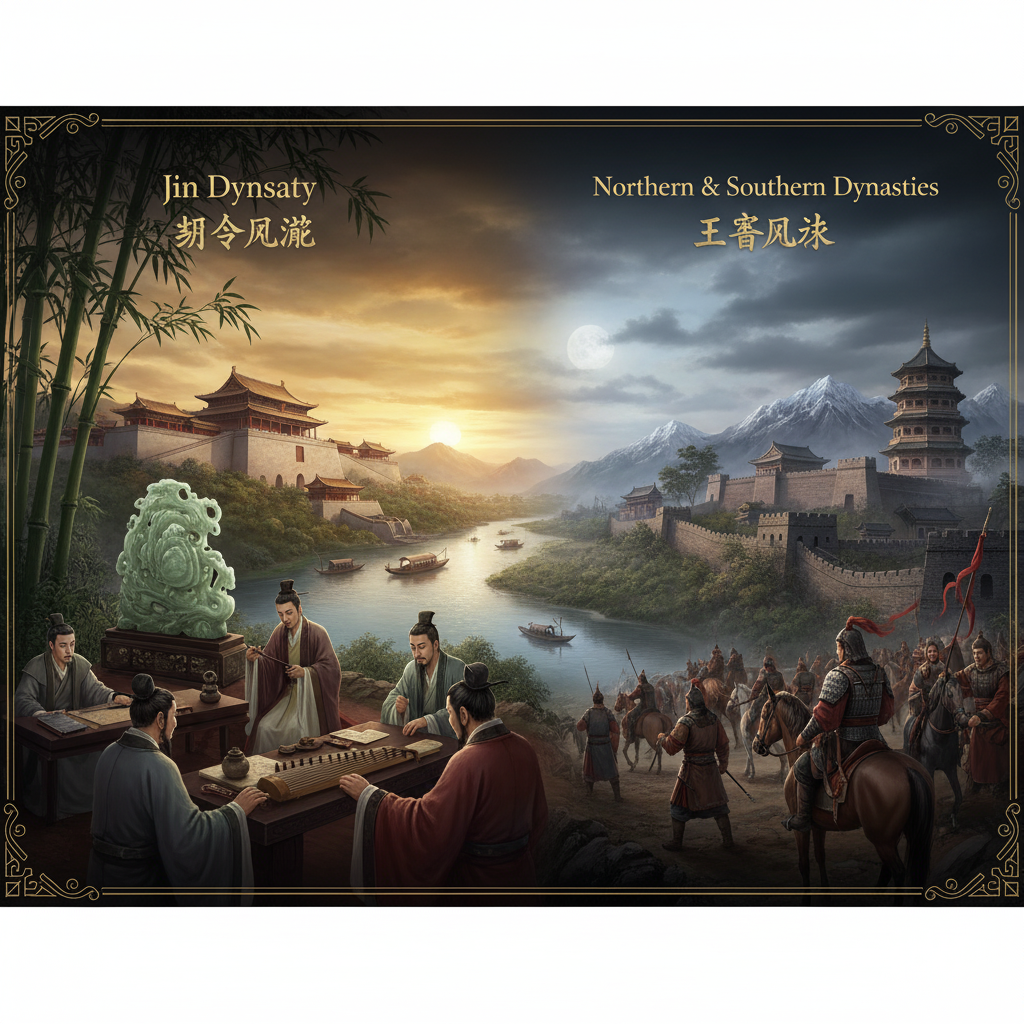
The Jin dynasty (266–420 CE) and the subsequent Northern and Southern dynasties (420–589 CE) represent a long period of internal strife and division in China between the unified Han and Sui dynasties. Characterized by civil war, invasions by nomadic groups, mass migration, and cultural fusion, this era was also a time of flourishing arts, philosophy, and the growth of Buddhism.
Invasion and collapse: While the Jin were embroiled in internal conflict, non-Chinese nomadic groups known as the “Five Barbarians” (Wu Hu) overran northern China, sacking the capital, Luoyang, in 311 CE. The execution of the Jin emperor in 318 CE effectively ended the Western Jin.
Battle of Fei River (383 CE): A decisive victory for the Eastern Jin, where a smaller Jin force defeated a much larger army of the Former Qin, temporarily halting invasions from the north and allowing the Jin to reclaim territory south of the Yellow River.
Liu Song (420–479 CE): The founder, Liu Yu, sought to empower military men of lower-class origin to prevent noble families from dominating the court. However, his successors proved weak and ineffective.
Southern Qi (479–502 CE): Founded by Xiao Daocheng, this dynasty was also short-lived due to internecine struggles within the ruling family.
Liang (502–557 CE): The long reign of its founder, Xiao Yan (Emperor Wu of Liang), was initially prosperous but was devastated by a rebellion in its later years.
Chen (557–589 CE): The weakest of the southern dynasties, the Chen was confined to the territory south of the Yangtze and was eventually conquered by the Sui dynasty, reunifying China.
Your article helped me a lot, is there any more related content? Thanks!