
The History of Salivary in America
Slavery in America refers to the system of chattel slavery that forcibly brought millions of Africans and their descendants to the British colonies and later the United States, where they were treated as property and subjected to brutal labor, family separations, and systemic violence. Beginning in the early 17th century, it became the economic backbone of the Southern colonies and states, fueling the growth of industries like tobacco, rice, indigo, and especially cotton. By the 19th century, it had entrenched racial hierarchies that shaped American society, politics, and economy. The institution’s legacy persists in ongoing racial inequalities, cultural narratives, and debates over reparations. Over approximately 246 years (1619–1865), an estimated 12.5 million Africans were forcibly transported across the Atlantic, with about 389,000 arriving directly in North America.
Origins and Early Development (17th Century)
Slavery’s roots in America trace to European colonialism and the transatlantic slave trade, driven by labor demands for cash crops. The first Africans arrived in Virginia in 1619 aboard a Dutch ship, initially treated as indentured servants but soon enslaved for life. By the mid-1600s, colonial laws codified racial slavery: Virginia’s 1662 statute declared that children of enslaved mothers inherited their status, and a 1669 law absolved masters of liability for killing slaves during punishment. In the North, slavery was smaller-scale but present in urban areas for domestic and maritime work; by 1700, about 5–10% of Northern populations were enslaved..
Slavery’s roots in America trace to European colonialism and the transatlantic slave trade, driven by labor demands for cash crops. The first Africans arrived in Virginia in 1619 aboard a Dutch ship, initially treated as indentured servants but soon enslaved for life. By the mid-1600s, colonial laws codified racial slavery: Virginia’s 1662 statute declared that children of enslaved mothers inherited their status, and a 1669 law absolved masters of liability for killing slaves during punishment. In the North, slavery was smaller-scale but present in urban areas for domestic and maritime work; by 1700, about 5–10% of Northern populations were enslaved.
The Middle Passage—the horrific Atlantic voyage—saw 10–20% mortality rates from disease, starvation, and abuse, with survivors auctioned in ports like Charleston and New Orleans. Early resistance included the 1739 Stone Rebellion in South Carolina, where enslaved people seized arms and marched toward Spanish Florida for freedom.
Expansion and Institutionalization
The American Revolution (1775–1783) exposed slavery’s contradictions—freedom rhetoric versus human bondage. While Northern states began gradual emancipation (e.g., Pennsylvania in 1780), the South doubled down, with the 1787 Constitution implicitly protecting slavery through clauses like the Three-Fifths Compromise (counting enslaved people as 3/5 of a person for representation) and the 20-year delay on banning the international slave trade.
The invention of the cotton gin in 1793 by Eli Whitney revolutionized the economy, making cotton “king” and expanding slavery westward into new territories. By 1860, the U.S. had 4 million enslaved people, comprising one-third of the South’s population and generating 60% of U.S. exports via cotton. The domestic slave trade, banned internationally in 1808, boomed, forcibly relocating 1 million people from the Upper South to the Deep South.
First Africans arrive in Jamestown, VA1619
Marks the beginning of African presence in English colonies; shifts from indenture to hereditary slavery.
Colonial slave codes enacted1660s–1700s
Legalize lifelong, inheritable slavery based on race; e.g., 1705 Virginia code bars enslaved literacy and assembly.
Stono Rebellion, SC1739
Largest slave uprising in colonial era; 44 Black people and 30 whites killed, leading to harsher laws.
American Revolution1776–1783
Enslaved people fight on both sides; inspires manumissions but entrenches Southern slavery.
Cotton gin invented1793
Triples cotton production; slavery expands to 1 million enslaved by 1810.
Missouri Compromise1820
Balances slave/free states; prohibits slavery north of 36°30′ line.
International slave trade banned1808
Shifts to brutal domestic trade; illegal smuggling continues.
Denmark Vesey plot, SC1822
Failed uprising; leads to executions and surveillance.
The Road to Abolition and the Civil War (Mid-19th Century)
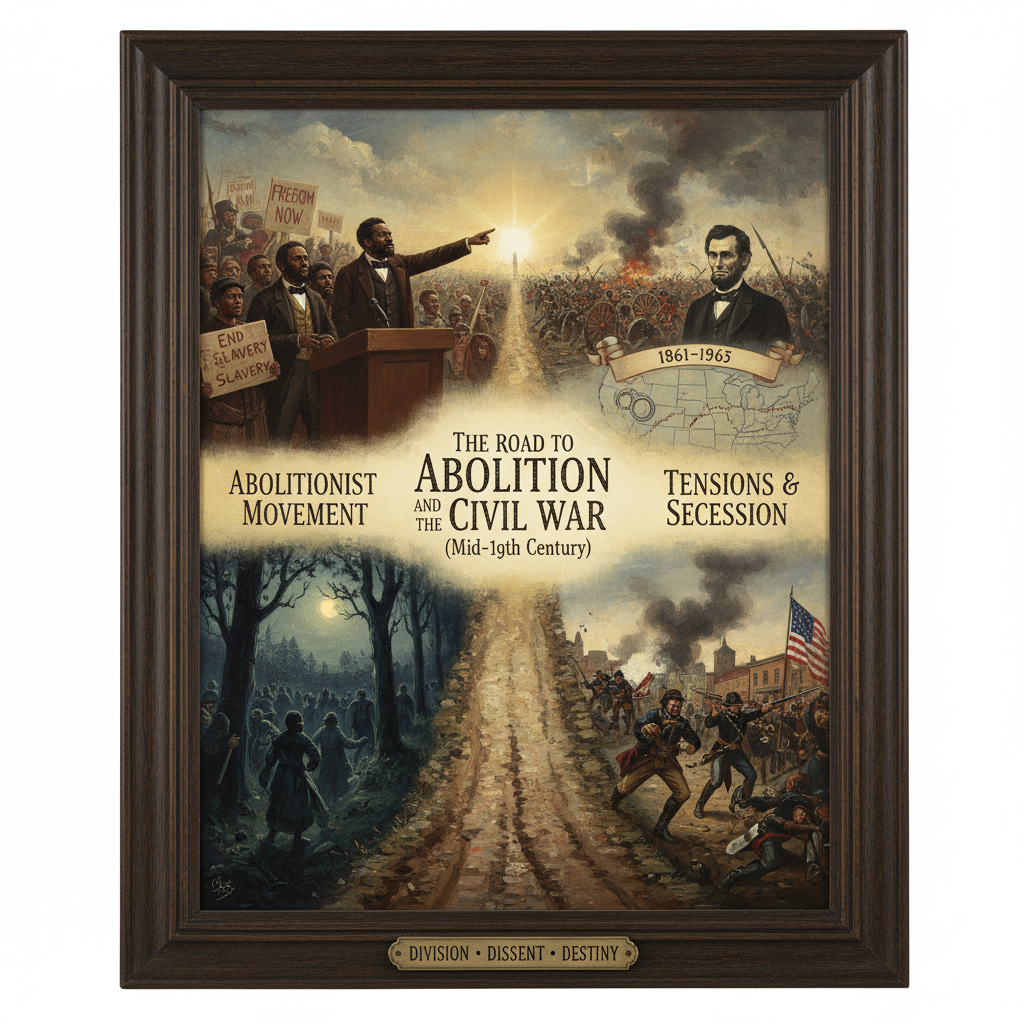
Abolitionism gained momentum with figures like Frederick Douglass (escaped slave and orator), Harriet Tubman (Underground Railroad conductor who freed 70+ people), and Sojourner Truth (advocate for women’s rights and abolition). The 1852 publication of Harriet Beecher Stowe’s Uncle Tom’s Cabin sold 300,000 copies, galvanizing Northern opposition. The Dred Scott v. Sandford Supreme Court decision (1857) ruled Black people non-citizens and invalidated anti-slavery laws, inflaming tensions.
Abraham Lincoln’s 1860 election prompted Southern secession, forming the Confederacy. The Civil War (1861–1865) killed 620,000–750,000 people, with the Emancipation Proclamation (1863) freeing 3.5 million enslaved in rebel states (though not border states). The 13th Amendment (1865) abolished slavery nationwide, but enforcement was uneven.
The 14th (1868) and 15th (1870) Amendments granted citizenship and voting rights to Black men. Reconstruction saw Black political gains—e.g., 2,000 Black officeholders, including Hiram Revels as the first Black U.S. Senator. However, the Compromise of 1877 ended federal oversight, ushering in Jim Crow laws that enforced segregation, disenfranchisement via poll taxes and literacy tests, and convict leasing (a form of debt peonage).
Impacts on America
Economic: Built wealth for white elites; by 1860, enslaved people were valued at $3.5 billion (more than all U.S. railroads and factories combined). It created disparities: the racial wealth gap persists, with Black households holding 13% of white households’ wealth today.
Social and Racial: Institutionalized white supremacy, leading to lynchings (4,000+ from 1882–1968), redlining, and mass incarceration. It shaped demographics—e.g., the Great Migration (1910–1970) of 6 million Black Southerners to Northern cities for opportunity.
Political: Sparked the Civil War, the deadliest U.S. conflict, and influenced civil rights movements. The 1960s Voting Rights Act addressed Reconstruction-era barriers.
Cultural: Enriched American music (spirituals, blues, jazz), literature (e.g., Douglass’s Narrative), and cuisine, but at immense human cost. Monuments and curricula debates continue, with 2021 marking the 400th anniversary of 1619.
Slavery’s abolition was a moral triumph, but its unaddressed legacies fuel contemporary issues like systemic racism and inequality. For deeper reading, resources like the National Museum of African American History and Culture provide primary sources. If you’d like focus on a specific era, figure, or aspect (e.g., economic data or resistance movements)
Your point of view caught my eye and was very interesting. Thanks. I have a question for you. https://accounts.binance.info/hu/register?ref=IQY5TET4
Pingback: 10 Rare Facts about World Presidents - Fact Hub