
The History Of Ancient Mesopotamia
Mesopotamia, often called the “Cradle of Civilization,” spans modern-day Iraq, parts of Syria, Turkey, and Iran. Situated between the Tigris and Euphrates rivers, its fertile land fostered some of the earliest human societies. This history traces Mesopotamia’s development from prehistoric times through its major civilizations until its decline, drawing on archaeological and textual evidence. 10,000–3100 BCE
Neolithic Period (c. 10,000–6000 BCE)
Agricultural Revolution: Around 10,000 BCE, communities in northern Mesopotamia (e.g., at sites like Göbekli Tepe) began domesticating plants and animals. By 7000 BCE, settlements like Çatalhöyük and Jarmo show evidence of farming wheat, barley, and livestock.
The Hassuna and Samarra cultures (c. 6000 BCE) developed early pottery and irrigation techniques, laying the groundwork for settled life.
Ubaid Period (c. 6500–3800 BCE)
First Urban Settlements: Named after Tell al-Ubaid, this period saw villages grow into proto-cities like Eridu. People built mud-brick houses and early temples.
Evidence of trade (obsidian, copper) and specialized labor indicates emerging social hierarchies. The Ubaid culture spread across southern Mesopotamia, influencing regions as far as the Persian Gulf.
Uruk Period (c. 4000–3100 BCE)
- Writing Emerges: Around 3100 BCE, cuneiform script developed for record-keeping, initially using pictographs on clay tablets. This marks the transition to history.
- Gilgamesh and Myth: The legendary king Gilgamesh, later immortalized in the Epic of Gilgamesh, may have ruled Uruk during this time.
Early Dynastic Period (c. 2900–2350 BCE)
- City-States Compete: Independent city-states like Ur, Lagash, and Kish vied for dominance. Each had its own ruler (ensi or lugal) and patron deity.
- Warfare and Diplomacy: The Stele of the Vultures (c. 2450 BCE) depicts Lagash’s victory over Umma, showing organized warfare. Alliances and trade flourished, with goods from the Indus Valley and Dilmun (Bahrain).
Excavations reveal lavish burials (c. 2500 BCE), including human sacrifices, indicating stratified societies.
Akkadian Empire (c. 2334–2154 BCE)
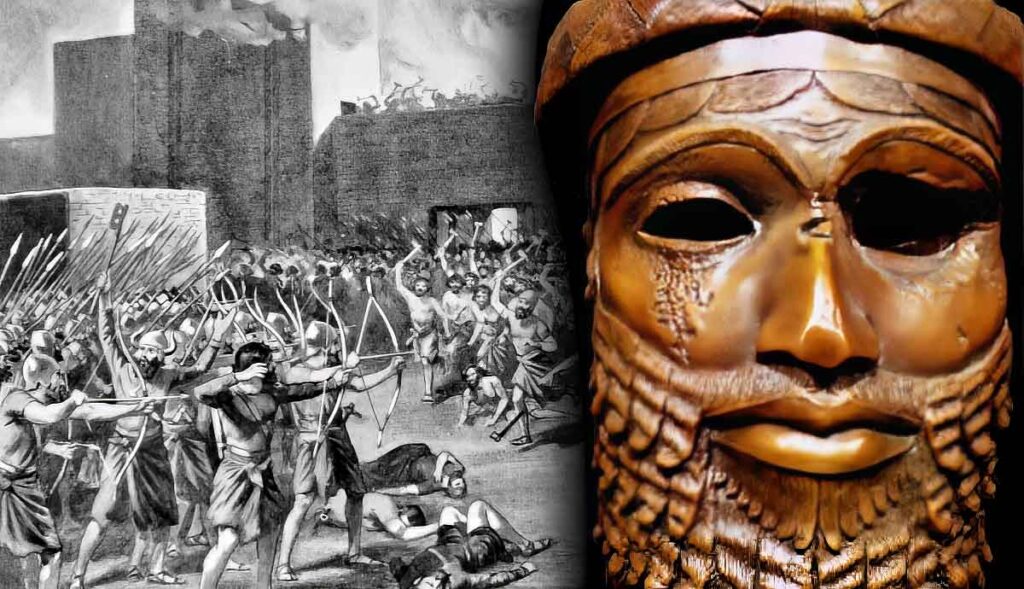
- Sargon of Akkad: Around 2334 BCE, Sargon unified Sumerian city-states, creating the first empire. He conquered from the Persian Gulf to the Mediterranean, establishing Akkad as his capital.
- Akkadian Language: The Semitic Akkadian language became dominant, though Sumerian persisted in religious contexts. Cuneiform adapted to write Akkadian.
- Decline: After Sargon’s dynasty, climate change and Gutian invasions weakened the empire, leading to its collapse by 2154 BCE.
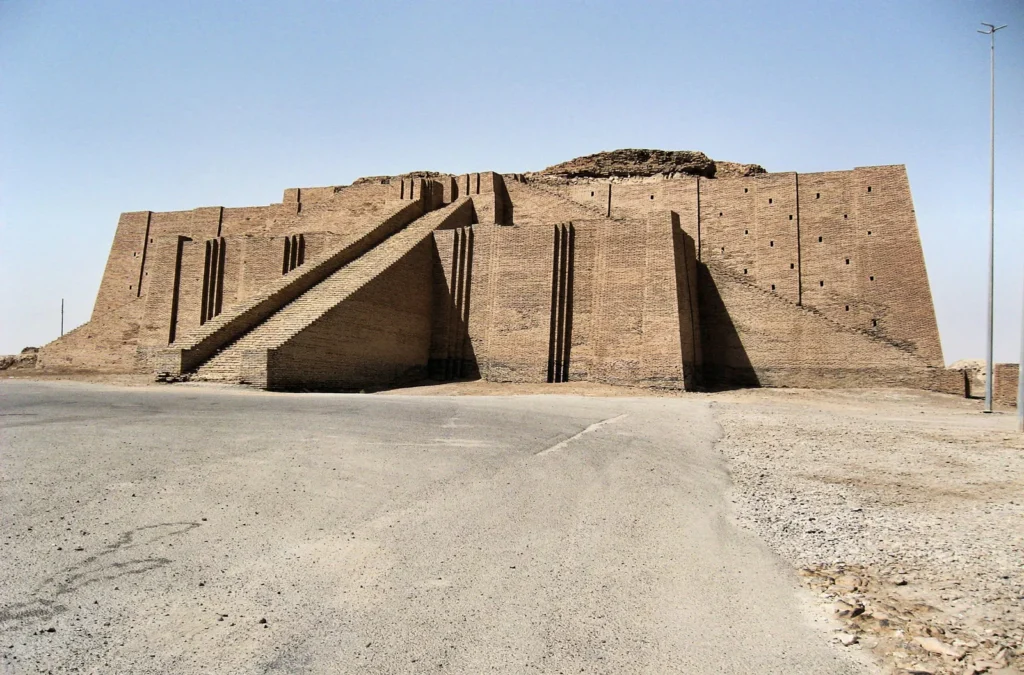
- Third Dynasty of Ur (Ur III): Ur-Nammu founded a new Sumerian state, building the Great Ziggurat of Ur. His law code, one of the earliest, regulated trade and justice.
- Administration: Ur III’s bureaucracy was highly organized, with detailed records of taxes, labor, and trade. The state controlled vast agricultural estates.
- Fall: Elamite invasions and internal revolts ended Ur III by 2004 BCE, fragmenting Mesopotamia again.
Old Babylonian and Assyrian Periods (c. 2000–1595 BCE)
- Hammurabi’s Reign: Hammurabi (r. 1792–1750 BCE) unified Mesopotamia under Babylon. His law code, inscribed on a basalt stele, detailed 282 laws covering trade, family, and crime.
- Cultural Flourishing: Babylon became a cultural hub, with advancements in mathematics (base-60 system) and astronomy. The Epic of Gilgamesh was standardized.
- Decline: After Hammurabi, the empire weakened. The Hittite sack of Babylon in 1595 BCE ended the dynasty.
- Trade Power: Assur emerged as a trading hub, with merchants exchanging tin and textiles with Anatolia. The Old Assyrian kingdom laid foundations for later dominance.
- Instability: Assyria faced internal strife and external pressures, limiting its early influence.
Middle Period of Mesopotamia
- Foreign Rulers: The Kassites, from the Zagros Mountains, ruled Babylon after the Hittite sack. They adopted Babylonian culture, maintaining stability.
- Kudurrus: Boundary stones (kudurrus) recorded land grants, showing sophisticated administration. Trade with Egypt and the Levant grew.
- Decline: Assyrian and Elamite pressures ended Kassite rule by 1155 BCE.
Middle Assyrian Empire (c. 1365–1050 BCE)
- Expansion: Kings like Ashur-uballit I (r. 1365–1330 BCE) expanded Assyrian territory, conquering Mitanni and challenging Babylon.
- Military Prowess: Assyria developed a professional army, using chariots and siege tactics. The empire’s bureaucracy rivaled earlier states.
- Weakening: Internal rebellions and Aramean migrations eroded Assyrian power by 1050 BCE.
Rise to Power: Starting with Adad-nirari II (r. 911–891 BCE), Assyria rebuilt its empire, conquering Mesopotamia, the Levant, and parts of Egypt.
Notable Kings:
- Ashurnasirpal II (r. 883–859 BCE): Known for brutal campaigns and the construction of a new capital at Kalhu (Nimrud).
- Sargon II (r. 721–705 BCE): Conquered Israel (722 BCE) and expanded trade networks.
- Ashurbanipal (r. 668–627 BCE): Created a vast library at Nineveh, preserving thousands of cuneiform texts, including literary and scientific works.
- Administration: A complex bureaucracy managed provinces, with governors reporting to the king. Mass deportations resettled populations to prevent rebellion.
- Fall: Overextension, internal revolts, and a Medo-Babylonian alliance led to Nineveh’s destruction in 612 BCE and the empire’s collapse by 609 BCE.
Rise and Decline(Fall)
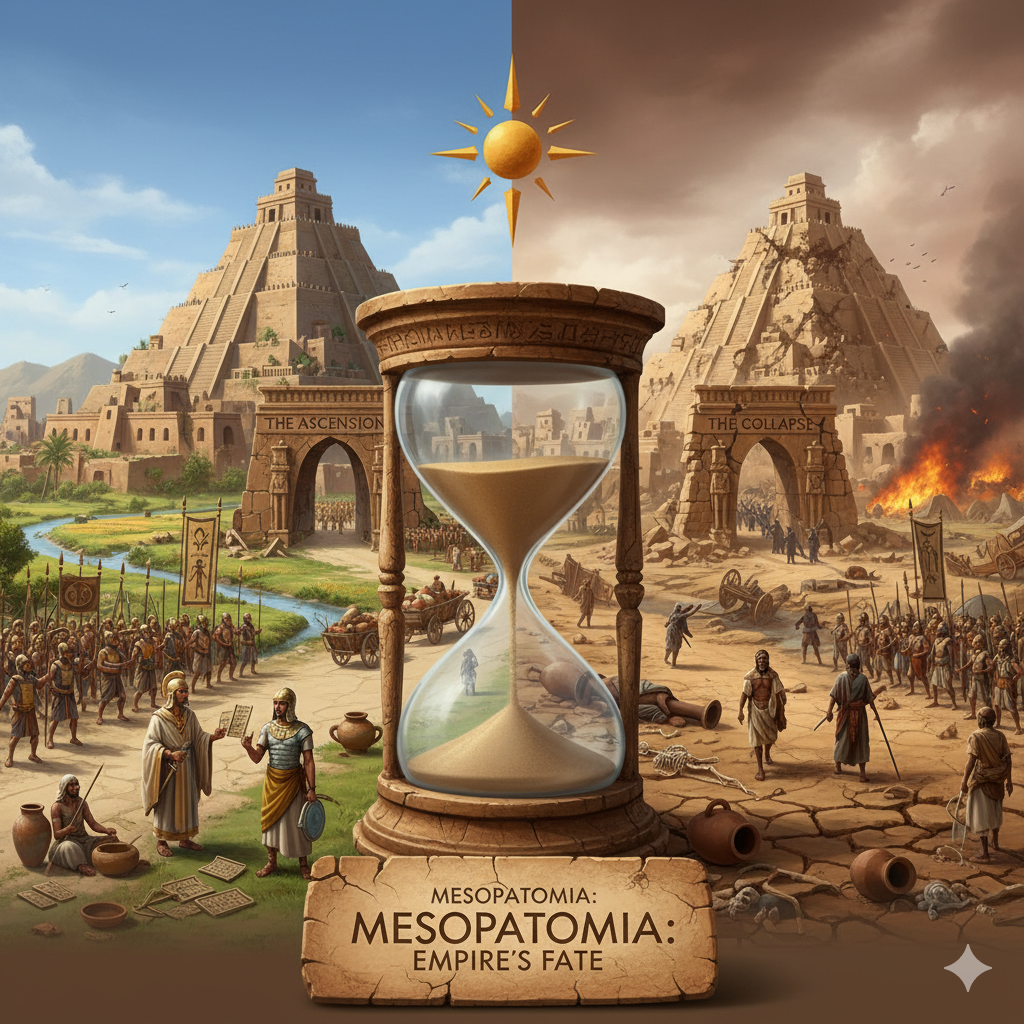
- Persian Rule: Under the Achaemenid Empire (539–331 BCE), Mesopotamia became a key province. Local traditions persisted, but political power shifted to Persia.
- Hellenistic and Parthian Periods: After Alexander the Great’s conquest (331 BCE), Greek influence grew. By the Parthian era (247 BCE–224 CE), Mesopotamia’s cities declined as trade routes shifted.
- Lasting Impact: Mesopotamia’s innovations—writing, law codes, mathematics, and urban planning—shaped later civilizations. Cuneiform texts preserved knowledge that influenced Greek, Roman, and Islamic cultures
Mesopotamia’s history spans over 7,000 years, from early farming villages to empires that shaped human civilization. Its cycles of unity and fragmentation, driven by conquest, trade, and innovation, left an enduring legacy. Archaeological discoveries, like those at Uruk and Nineveh, continue to reveal its complexity.
Your article helped me a lot, is there any more related content? Thanks!