
The Contributions of Isaac Newton
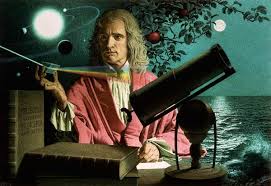
Isaac Newton, born on January 4, 1643, in Woolsthorpe, Lincolnshire, England, stands as one of the most influential figures in the history of science. A polymath whose work spanned mathematics, physics, astronomy, alchemy, and theology, Newton’s contributions fundamentally shaped the modern scientific worldview. His life was marked by profound intellectual pursuits, often conducted in solitude, especially during his time at Trinity College, Cambridge, where the closure due to the Great Plague in 1665–1666 allowed him uninterrupted focus on his groundbreaking ideas. Newton’s magnum opus, Philosophiæ Naturalis Principia Mathematica (Mathematical Principles of Natural Philosophy), published in 1687, encapsulated many of his key discoveries. This essay explores Newton’s pivotal contributions to mathematics and physics, highlighting how his innovations not only advanced these fields independently but also intertwined them to lay the foundations for classical mechanics and beyond. Through his inventions, laws, and theories, Newton transformed abstract concepts into practical tools that continue to underpin scientific inquiry today.
Beyond calculus, Newton made significant strides in algebra and series expansions. He generalized the binomial theorem, extending it to non-integer exponents, which facilitated the expansion of expressions like (1 + x)^n where n could be fractional or negative. This theorem, detailed in his letters to Leibniz and others, became a cornerstone for approximating functions and solving equations in infinite series. Newton’s work on infinite series also included methods for approximating roots and solving polynomial equations, as seen in his Arithmetica Universalis (Universal Arithmetic), published posthumously in 1707. He pioneered interpolation techniques, such as Newton’s divided difference interpolation formula, which is still used in numerical analysis today.
Contribution to Mathematics
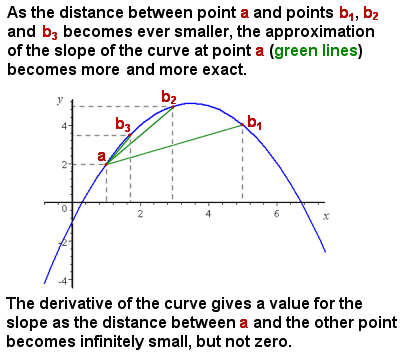
Newton’s work in mathematics was revolutionary, providing essential tools that enabled advancements in physics and other sciences. Perhaps his most celebrated mathematical achievement was the development of calculus, a branch of mathematics dealing with rates of change and accumulation. Newton invented what he called the “method of fluxions” in the mid-1660s, a system for calculating instantaneous rates of change, which is now known as differential and integral calculus. This invention occurred independently of Gottfried Wilhelm Leibniz, who developed a similar system around the same time, leading to a famous priority dispute. Newton’s calculus allowed for the precise modeling of continuous change, such as the velocity of falling objects or the orbits of planets. He applied it to solve problems in geometry and algebra that were previously intractable, demonstrating its power in his early manuscripts like De Analysi per Aequationes Numero Terminorum Infinitas (On Analysis by Equations with an Infinite Number of Terms), written in 1669 but not published until later.
These mathematical tools provided the rigor needed for his physical theories, illustrating the symbiotic relationship between the two disciplines.
Contributions to Physics
In physics, Newton’s laws of motion and theory of universal gravitation formed the bedrock of classical mechanics, revolutionizing our understanding of the physical world. His three laws of motion, articulated in the Principia, describe the behavior of objects under forces. The first law, often called the law of inertia, states that an object at rest remains at rest, and an object in motion continues in uniform motion unless acted upon by an external force. The second law quantifies this by relating force to mass and acceleration (F = ma), providing a mathematical framework for dynamics. The third law asserts that for every action, there is an equal and opposite reaction, explaining phenomena from rocket propulsion to everyday interactions.
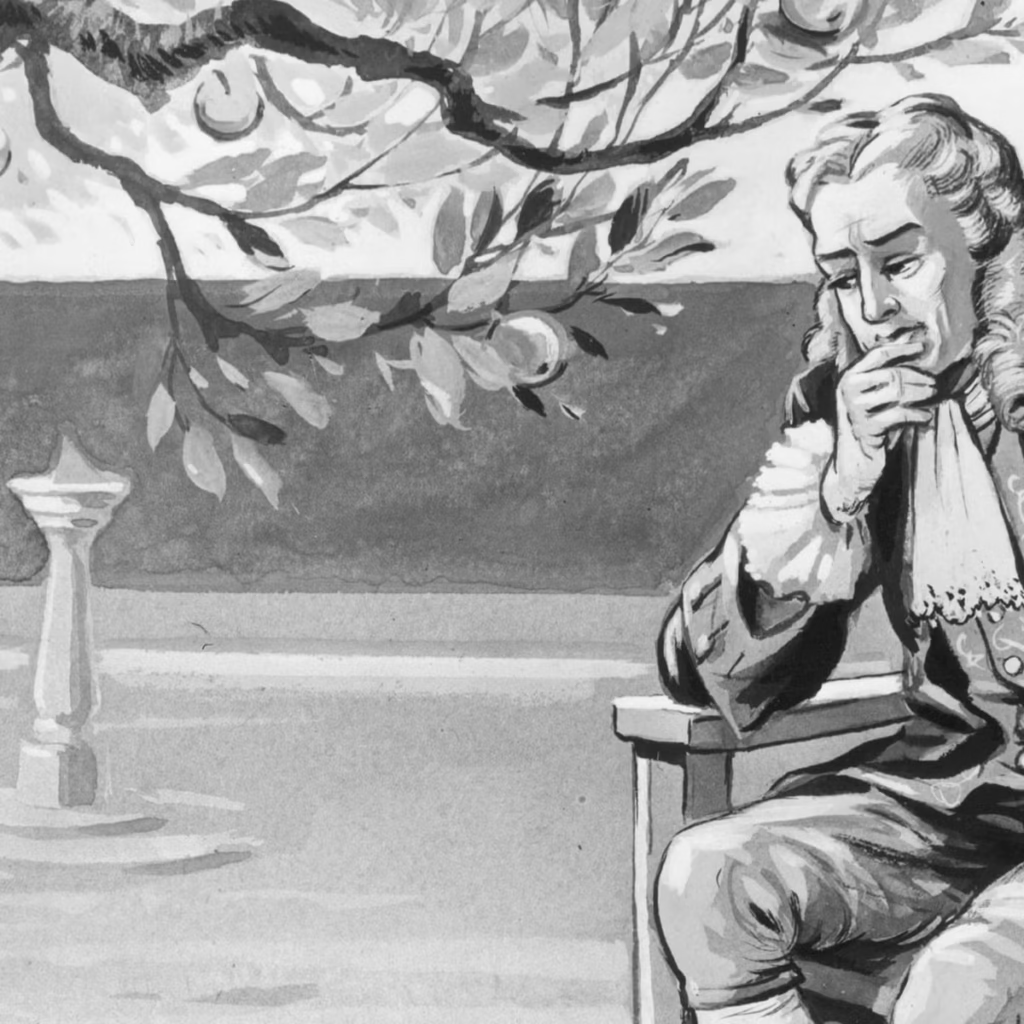
These laws culminated in Newton’s law of universal gravitation, which posits that every particle attracts every other particle with a force proportional to the product of their masses and inversely proportional to the square of the distance between their centers (F = G * (m1 * m2) / r²). This theory unified terrestrial and celestial mechanics, explaining why apples fall to the ground and why planets orbit the sun. Legend has it that the idea struck Newton while observing a falling apple, though this is likely apocryphal. Using calculus, Newton derived Kepler’s laws of planetary motion from his gravitational principle, demonstrating elliptical orbits and predicting perturbations in planetary paths. This work not only resolved longstanding astronomical puzzles but also enabled precise calculations for navigation, ballistics, and later space exploration.Newton’s contributions extended to optics, where he conducted pioneering experiments on light and color. In his book Opticks (1704), he detailed how white light decomposes into a spectrum of colors through refraction in a prism, refuting the prevailing theory that colors were modifications of white light.
He built the first reflecting telescope in 1668, using a curved mirror to avoid chromatic aberration, which improved astronomical observations and influenced telescope design for centuries. Newton’s corpuscular theory of light, treating it as particles, anticipated aspects of quantum mechanics, though it competed with Christiaan Huygens’ wave theory.Newton explored viscosity, resistance in fluids, and the speed of sound, laying groundwork for hydrodynamics. His work on centripetal force, essential for circular motion, was applied to pendulum experiments and lunar orbits. Additionally, Newton’s insights into thermodynamics, such as his law of cooling, described how hot bodies lose heat proportionally to the temperature difference with their surroundings.
Interconnections and Broader Impact
Newton’s genius lay in integrating mathematics and physics seamlessly. Calculus was indispensable for deriving his physical laws; without it, quantifying acceleration or gravitational fields would have been impossible. For example, in the Principia, he used geometric limits akin to derivatives to prove propositions about motion under inverse-square forces. This mathematical physics approach shifted science from qualitative descriptions to quantitative predictions, fostering the Scientific Revolution.
Isaac Newton’s contributions endure as pillars of modern science. In mathematics, his calculus democratized the study of change, enabling advancements in technology and theory. In physics, his laws provided a unified framework that dominated until Einstein’s relativity. Newton’s work exemplified empirical rigor and mathematical elegance, inspiring generations. Though he humbly remarked, “If I have seen further, it is by standing on the shoulders of giants,” his shoulders have supported countless others.
Newton’s legacy transcends academia; his ideas underpin everyday technologies, from GPS satellites relying on gravitational corrections to engineering designs based on his motion laws. Despite personal quirks—his alchemical pursuits and theological writings—he remains a symbol of human curiosity. In an era of rapid scientific progress, reflecting on Newton’s achievements reminds us of the power of individual insight to reshape our understanding of the universe.