
King of JORDAN: Abdullah 2 Biography
King Abdullah II bin Al-Hussein was born on January 30, 1962, in Amman, Jordan, as the eldest son of King Hussein and British-born Princess Muna al-Hussein (Antoinette Gardiner).
He belongs to the Hashemite dynasty, claiming descent from the Prophet Muhammad through his daughter Fatimah and son-in-law Ali, making him a 42nd-generation direct descendant.
As a child, Abdullah was named heir apparent under Jordan’s 1952 constitution but lost the title in 1965 amid political tensions, with it passing to his uncle, Prince Hassan.
He has four full brothers and several half-siblings from his father’s multiple marriages. Explore the biography, leadership style, and major reforms of King Abdullah II of Jordan. A detailed look into the Jordan royal family and Abdullah II’s influence in the Middle East.
Biography of Abdullah II
Abdullah’s early schooling took place in Amman at the Islamic Educational College, followed by studies in England at St. Edmund’s School.
He then attended Eaglebrook School and Deerfield Academy in the United States, where he later served as commencement speaker for the class of 2000.
In 1980, he trained at the Royal Military Academy Sandhurst in the UK. He pursued further studies, including a one-year course in Middle Eastern affairs at Pembroke College, Oxford (1982); advanced international affairs research at Georgetown University’s School of Foreign Service (1987);
the British Staff College (1990); and a defense resources management course at the U.S. Naval Postgraduate School.
Family of King Abdullah II
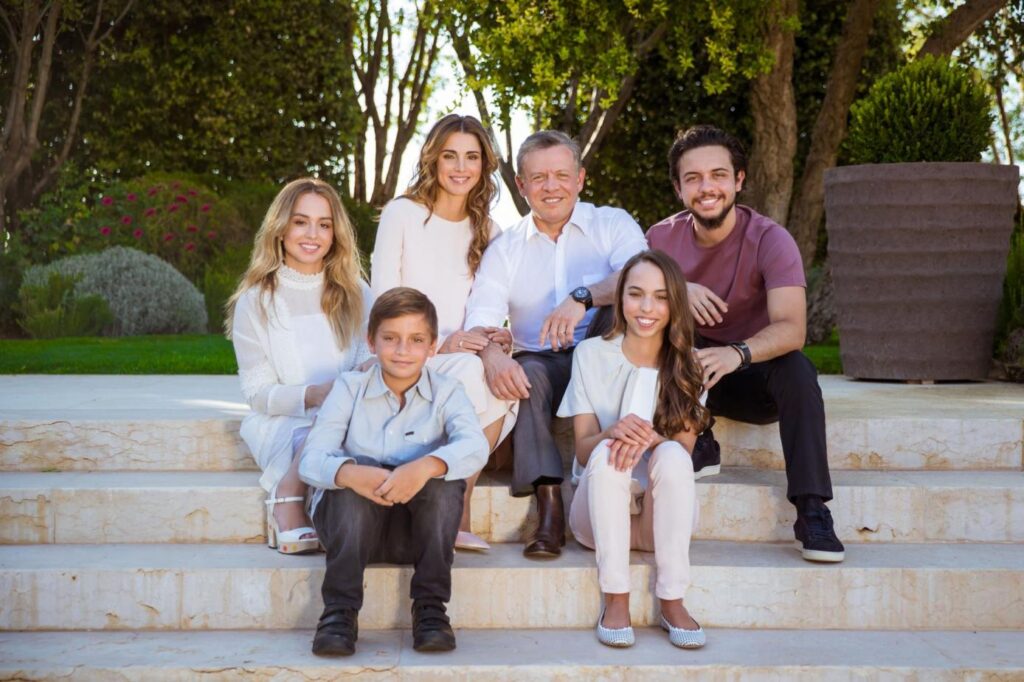
On June 10, 1993, Abdullah married Rania al-Yassin (a Palestinian-Jordanian banker), whom he met at a 1993 dinner. They have four children.
Crown Prince Hussein (born 1994, heir since 2009, married Rajwa Al-Saif in 2023; first child born 2024); Princess Iman (born 1996, first child in 2025); Princess Salma (born 2000); and Prince Hashem (born 2005).
In 2004, he removed half-brother Prince Hamzah as crown prince. Half-sister Princess Haya fled to the UK in 2019 amid a custody dispute.
In 2021, Abdullah foiled a sedition plot involving Hamzah, placing him under house arrest; Hamzah renounced his title.
King Abdullah II Wives
Queen Rania Al Abdullah (née Rania Al-Yassin) was born on August 31, 1970, in Kuwait City to Palestinian parents, Faisal Sedki Al-Yassin, a doctor, and Ilham Yassin.
Her family fled Kuwait during the 1991 Gulf War, relocating to Amman, Jordan, where she grew up among thousands of other Palestinian refugees.
This experience instilled in her a profound empathy for displaced populations, influencing her later advocacy.
She attended the New English School in Kuwait and earned a degree in business administration from the American University in Cairo in 1991.
Rania met Prince Abdullah bin Al-Hussein at a dinner party in Amman in early 1993, introduced by mutual friends.
Their courtship was swift; they married on June 10, 1993, in an intimate ceremony at Zahran Palace.
At the time, she was unaware he would one day become king. When King Hussein died on February 7, 1999, Abdullah ascended the throne, and Rania, then 28, was elevated from princess to queen consort—one of the youngest queens in modern history.
She became a naturalized Jordanian citizen upon her marriage.
Children of King Abdullah II
Crown Prince Hussein
(born June 28, 1994): The heir apparent since 2009. He married Rajwa Al Saif in June 2023; their first child, Princess Iman, was born in August 2024.
Princess Iman
(born September 27, 1996): Recently gave birth to her first child, a daughter named Amina, in February 2025, making Rania a grandmother for the second time.
Princess Salma
(born September 26, 2000): Known for her interest in aviation and humanitarian work.
Prince Hashem
(born January 30, 2005): The youngest, sharing a birthday with his father.
Public Image of King Abdullah II
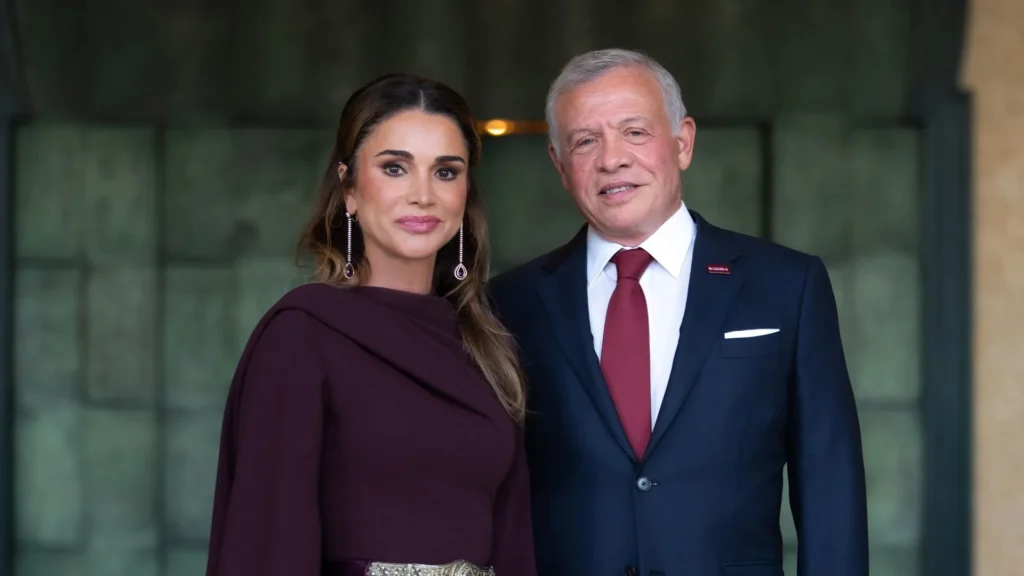
Rania is renowned for her modern style, blending Western fashion with Arab heritage, and her active social media presence.
nearly 10 million followers on X (formerly Twitter) as @QueenRania—where she shares insights on global issues.
She has authored children’s books like The Sandwich Swap (2010) to foster kindness. Critics occasionally note palace tensions with former Queen Noor, but Rania’s focus remains on public service.
Role and Powers
King Abdullah II is a constitutional monarch but holds significant executive and legislative powers.
He is the head of state and commander-in-chief of the armed forces.
with the authority to appoint the prime minister, the directors of security agencies, and members of the Senate.
He has focused on economic modernization and promoting interfaith dialogue while navigating complex regional challenges, including the Arab-Israeli conflict, the Iraq War, and the Syrian Civil War.
King of Jordan Family tree
King Abdullah I (1882–1951) Founder of the Emirate of Transjordan (1921) and Kingdom of Jordan (1946); assassinated in Jerusalem.
- Spouse: Queen Musbah bint Nasser (1886–1968)
- Children:
- Princess Talal (1900–1982)
- Prince Talal (1909–1972; succeeded as King Talal, abdicated 1952 due to health)
- Spouse: Queen Zein al-Sharaf (1916–1994)
- Children:
- King Hussein (1935–1999; reigned 1952–1999; married four times)
- First wife: Dina bint Abdul-Hamid (1932–2019; m. 1955, div. 1957)
- Princess Alia bint Hussein (1956– ) Half-sister to Abdullah; m. Muhammad Al-Saleh; 2 children
- Second wife: Princess Muna al-Hussein (b. 1941; m. 1961, div. 1972)
- King Abdullah II (b. 1962; reigning since 1999)Eldest son and heir to Hussein
- Spouse: Queen Rania Al Abdullah (b. 1970; m. 1993; Palestinian-Jordanian)
- Children:
- Crown Prince Hussein bin Abdullah (b. 1994; heir apparent since 2009)
- Spouse: Princess Rajwa Al Saif (b. 1994; m. 2023)
- Children:
- Princess Iman bint Al Hussein (b. August 3, 2024) First grandchild
- Princess Iman bint Abdullah (b. 1996)
- Spouse: Jameel Alexander Thermiotis (m. 2023)
- Children:
- Princess Amina bint Al Hussein (b. February 2025) Second grandchild
- Princess Salma bint Abdullah (b. 2000; first Jordanian woman to earn a pilot’s license, 2020)
- Prince Hashem bin Abdullah (b. 2005; second in line after Salma)
- Crown Prince Hussein bin Abdullah (b. 1994; heir apparent since 2009)
- Prince Faisal bin Hussein (b. 1963) Half-brother to Abdullah
- Spouse: Alia Arafa (m. 1992)
- Children: Prince Omar (b. 1997), Princess Ayah (b. 2000), Princess Sara (b. 2003)
- Princess Aisha bint Hussein (b. 1968) Half-sister
- Twice married; 3 children
- Princess Zein bint Hussein (b. 1968) Half-sister; twin of Aisha
- Spouse: Muhammad Al-Saleh (m. 1994)
- Children: Prince Omar (b. 1997), Princess Haya (b. 2002), Prince Abdullah (b. 2007)
- King Abdullah II (b. 1962; reigning since 1999)Eldest son and heir to Hussein
- Third wife: Queen Alia al-Hussein (1948–1977; m. 1972, killed in helicopter crash)
- Princess Haya bint Hussein (b. 1974) Half-sister; fled to UK in 2019 amid dispute with ex-husband Sheikh Mohammed bin Rashid Al Maktoum
- Prince Ali bin Hussein (b. 1975) Half-brother; President of Jordan Football Association
- Spouse: Princess Rym al-Riyashi (b. 1973; m. 2004)
- Children: Princess Jalila (b. 2004), Prince Abdullah (b. 2007)
- Fourth wife: Queen Noor al-Hussein (b. 1951; m. 1978, widowed 1999; American-born)
- Princess Iman bint Hussein (b. 1980; m. 2005 to Zaid bin Rajaa) Half-sister
- Children: 2 daughters
- Prince Hamzah bin Hussein (b. 1980; half-brother; crown prince 1999–2004, stripped of title in 2021 sedition plot, under house arrest)
- Spouse: Princess Basmah bint Saud (b. 1981; m. 2012; detained 2021–2023)
- Children: Princess Haya (b. 2013), Princess Zein (b. 2014), Princess Noor (b. 2016), Princess Badiya (b. 2019), Princess Nafisa (b. 2020), Prince Hussein (b. 2022), Prince Muhammad (b. 2023)
- Prince Hashim bin Hussein (b. 1981) Half-brother
- Spouse: Princess Fahdah (b. 1982; m. 2017)
- Children: Princess Haalah (b. 2007), Princess Raiyah (b. 2009), Princess Fatima (b. 2012), Prince Hussein (b. 2015), Prince Muhammad (b. 2019)
- Princess Raiyah bint Hussein (b. 1986) Half-sister; m. 2010 to Al Saud bin Musa’id
- Children: Prince Hussein (b. 2012), Princess Rajwa (b. 2014)
- Princess Iman bint Hussein (b. 1980; m. 2005 to Zaid bin Rajaa) Half-sister
- First wife: Dina bint Abdul-Hamid (1932–2019; m. 1955, div. 1957)
- Prince Muhammad (1919–1996) Uncle to Hussein
- Prince Hassan bin Talal (b. 1947; uncle to Abdullah, crown prince 1965–1999)
- Spouse: Princess Sarvath (b. 1947; m. 1968)
- Children:
- Princess Basmah (b. 1971)
- Prince Rashid (b. 1974; m. Zeina; 2 children)
- Prince Hassan (b. 1977)
- Princess Tala (b. 1981)
- Prince Muhsin (b. 1984)
- King Hussein (1935–1999; reigned 1952–1999; married four times)
- Other spouses of Abdullah I: Queen Suzdil Khanum (d. 1953), Nahda bint Uman (d. 1977), Wijdan Hanim (d. 1943)
- Additional children: Princesses Naif, Aisha, and others (deceased)
King of Jordan Net Worth
As of 2025, King Abdullah II bin Al-Hussein’s net worth is estimated at $750 million.
This figure is widely reported by financial and celebrity wealth trackers, reflecting his position as a long-reigning monarch with significant personal and inherited assets.
King Abdullah IIn Height
King Abdullah II bin Al-Hussein stands at approximately 5 feet 6 inches (168 cm) tall.
This estimate is consistent across biographical sources and visual comparisons from public appearances, though official measurements are not publicly disclosed by the Jordanian royal family.
Variations in reports (e.g., 5’3″–5’6″ or 160–170 cm) often stem from informal observations or side-by-side photos with other leaders, such as his father King Hussein (around 5’3″) or taller figures like Spain’s King Felipe VI (6’5″).
His military background and active lifestyle may contribute to his fit physique, but height remains a personal trait without confirmed royal records.
King Abdullah II of Jordan: Major Work and Achievements (1999–2025)

King Abdullah II has ruled Jordan for over 26 years (as of November 2025), making him the longest-serving current Arab head of state.
His reign is defined by four broad pillars: economic modernization, political reform, regional stability, and global advocacy.
1. Economic Modernization & Development
Debt-to-GDP ratio reduced from >100% in 1999 to ~60% by 2011 and stabilized around 85–90% even after refugee crises.
Signed the first Arab–U.S. Free Trade Agreement (2001), eliminating tariffs by 2010.
Privatized ~$2 billion in state assets (telecom, phosphates, potash) while retaining strategic control.
2. Political & Institutional Reforms
Constitutional amendments (2011, 2014, 2016, 2022) — over one-third of the constitution changed:
Introduced municipal decentralization (2015–2017 elected governorate councils).
2022 reforms: Women’s quota in parliament raised, youth quota added, prime minister elected by largest parliamentary bloc (from 2026 onward).
Electoral law changes (2012, 2016, 2022) moving gradually toward proportional representation and party-based politics.
4. Foreign Policy & Regional Stability
Guardian of Jerusalem’s Islamic and Christian holy sites (official custodian role reaffirmed 2013, 2023).
Strong advocate for two-state solution; repeatedly blocked Israeli attempts to alter status quo at Al-Aqsa (most recently 2023–2025).
Hosted 1.3 million Syrian refugees since 2011 without major unrest.
Brokered discreet back-channels between Israel and Arab states (pre-Abraham Accords) and between Palestinians and Israelis.
5. Global Advocacy & Soft Power
Coined the term “Shia Crescent” (2004) — influenced U.S. and Western thinking on Iranian expansion.
Launched the Amman Message (2004–2005) — the most comprehensive Muslim consensus against extremism (endorsed by 500+ scholars).
Initiated UN World Interfaith Harmony Week (resolution adopted 2010).
Personally led Gaza aid airdrops (2024) and medical evacuations during the 2023–2025 conflict.
6. Personal & Symbolic Achievements
First Arab leader to address the European Parliament (2015) and the U.S. Congress (2007, 2017).
Youngest serving head of state when he ascended (age 37).
Appeared (incognito) in 2017 HBO documentary “Cries from Syria” to highlight refugee plight.
What is King Abdullah II famous for?
Abdullah is known for promoting interfaith dialogue and a moderate understanding of Islam.
The longest-serving current Arab leader, he is custodian of the Muslim and Christian religious sites in Jerusalem, a position held by his dynasty since 1924.
What is Jordan’s original religion?
Religion Sunni Islam is the state religion and 90% of Jordanians are followers. Added to this, 8% are Christian (Orthodox, Coptic, Greek Catholic, Armenian).
Is Jordan Sunni or Shia?
The Hashemite Kingdom of Jordan is a majority Muslim country with 97.2% of the population following Sunni Islam while a small minority follow Shiite branches.
What country is 90% Shia?
In Iran, an officially Shia country since 1501, around 92% of Muslims are Shia. 65–85% of Muslims in Azerbaijan are Shia. Shia, mostly of the Zaydi sect, form a large minority (45%) of the population in Yemen. About 15% of Turkey’s population belong to the Alevi sect of Shi’i Islam.