Abdul Sattar Edhi-the Angel of humanity
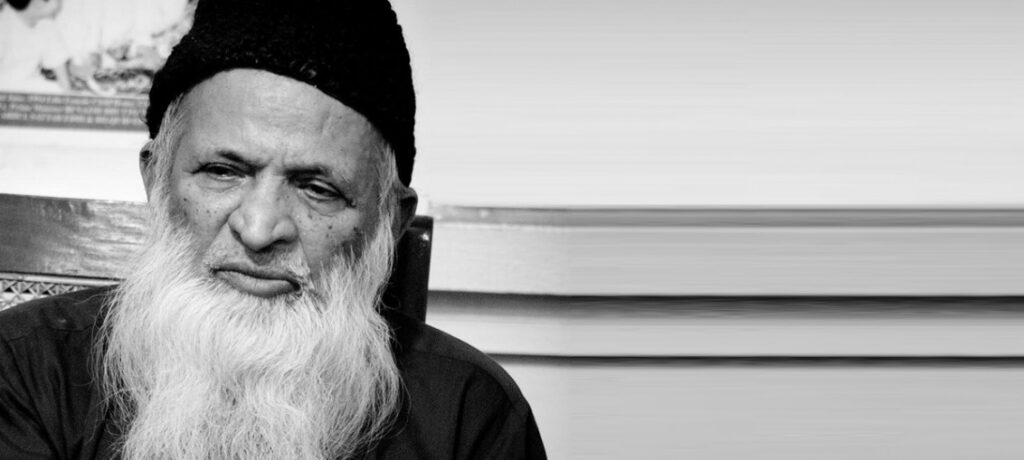
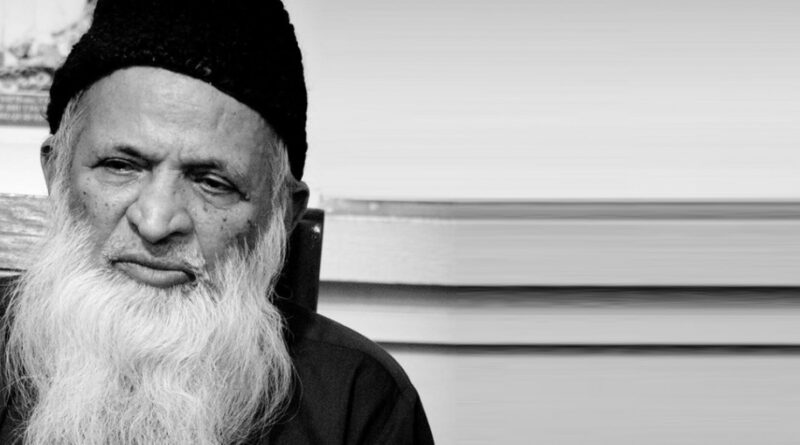
Abdul Sattar Edhi was a prominent Pakistani philanthropist and humanitarian, widely known as the “Angel of Mercy” for his selfless dedication to serving humanity, regardless of race or religion. He founded the Edhi Foundation, which grew from a single dispensary into an extensive network of hospitals, homeless shelters, orphanages, and the world’s largest fleet of ambulances, all funded by private donations and volunteer efforts. Edhi’s humanitarian vision was global, responding to natural disasters and famine, and he was nominated multiple times for the Nobel Peace Prize for his extensive work.
Key Aspects of Edhi’s Work
The Edhi Foundation:
Edhi established the Edhi Foundation in 1951, starting with a simple donation box and an old van.
Extensive Services:
The foundation provides a wide range of services, including hospitals, homeless shelters, drug rehabilitation centers, orphanages, air ambulance services, and support for missing persons.
Global Impact:
- While focusing on Pakistan and South Asia, the foundation has also provided aid during natural disasters and famines in Europe and the Americas.
Selflessness and Devotion:
Edhi famously lived a life of asceticism, dedicating his entire life and all the foundation’s funds to helping others, with never a penny spent on himself. His personal philosophy was that “My mission is to love human beings”.
Resilience and Strength:
Despite facing criticism and exhaustion from his work, Edhi maintained a humble smile and was known for his unwavering commitment to his mission.
Legacy and Recognition
Widespread Respect:
Edhi was revered as one of Pakistan’s most respected and legendary figures.
Nobel Peace Prize Nominations:
He was nominated for the Nobel Peace Prize multiple times, recognizing his global efforts in humanitarianism.
Inspiration for Humanity:
Edhi’s life and work inspired countless individuals and demonstrated that true religion is humanity itself. The edhina.org website highlights how he believed in the inherent goodness of humanity and dedicated his life to serving it.

- Poor Patient Ambulance
- Edhi Land Ambulance Service was initially started by including a second hand Hillman Pickup Truck and that was refurbished into the first ambulance, thereby coining “Poor Patient Ambulance”.
Edhi Biography
Abdul Sattar Edhi was known for his exceptional qualities of humility, compassion, and selfless service. He dedicated his life to helping the poor and destitute, establishing the Edhi Foundation which became a global symbol of humanitarianism. His unwavering commitment to serving humanity, regardless of background or belief, earned him immense respect and admiration.
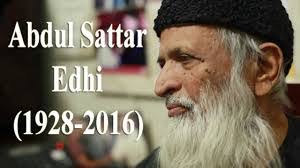
- Humility:
Despite overseeing a vast charitable organization, Edhi lived a simple life, owning only two sets of clothes and residing in a small room adjacent to the foundation’s office.
- Compassion:
Edhi’s deep empathy for the suffering of others drove him to provide care for the orphaned, abandoned, elderly, and mentally ill.
- Selfless Service:
He dedicated his life to serving humanity, tirelessly working to provide medical care, shelter, and other essential services to those in need.
- Integrity and Honesty:
Edhi’s honesty and integrity earned him the trust and respect of people from all walks of life.
- Perseverance:
He continued his humanitarian work despite facing personal threats and challenges.
- Courage:
Edhi demonstrated courage in making unpopular decisions and standing up for his beliefs.
- Leadership:
He successfully mobilized resources and volunteers to build the Edhi Foundation into a global force for good.
- Focus on Deeds:
Edhi believed in action over words, emphasizing that one’s faith should be demonstrated through deeds rather than just spoken praise.
- Inspiration:
His life and work continue to inspire countless individuals to pursue acts of kindness and compassion.
Abdul Sattar Edhi’s social welfare services are spanned over his entire life by offering exclusive sacrifices in many areas—like personal and social life as well as his personal business, and so on. He is serving the humanity selflessly and dedicatedly without expecting for any monetary benefit or financial gain. He has buried over 200,000 unclaimed dead bodies
. Bilquis Edhi
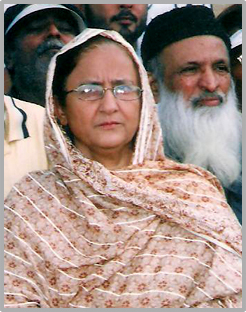
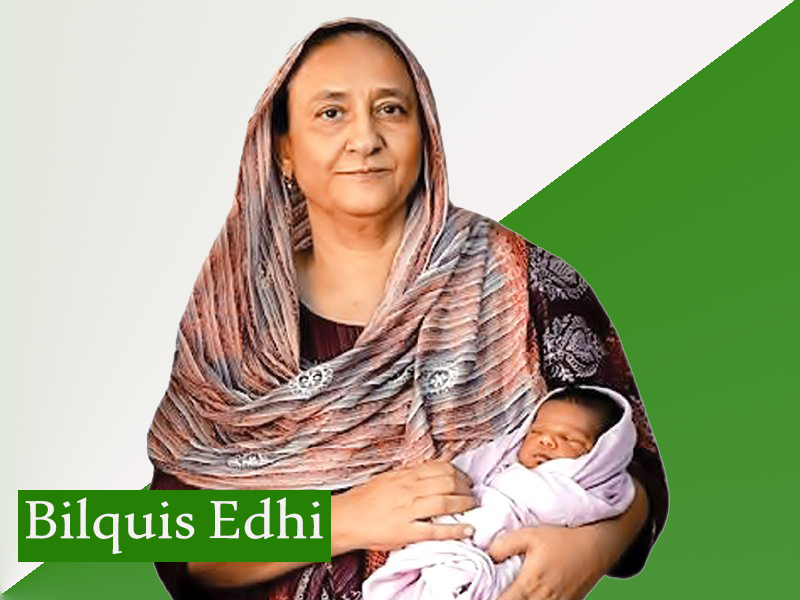
. Bilquis Edhi. Bilquis Bano Edhi HI (Urdu: 41; بلقیس ایدھی August 1947 – 15 April 2022) was a Pakistani nurse who helped save the lives of over 16,000 children. During her career as a nurse and marriage to Abdul Sattar Edhi, she was one of the most active philanthropists in Pakistan. In 1965, Edhi married Bilquis Bado, a nurse who worked at an Edhi Trust dispensary. They had four children, two daughters, and two sons
Abdul Sattar Edhi daughter( kubra EDHI)
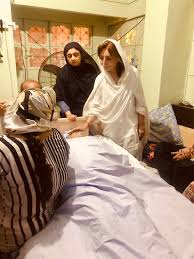
Abdul Sattar Edhi’s daughter is named Kubra Edhi, and she is a Director at the Edhi Foundation, overseeing the Edhi centre for women and children in Clifton. She is involved in the foundation’s management, financial operations, and fundraising efforts. Her Role in the Edhi Foundation
- Director: Kubra serves as a Director at the Head Office of the Edhi Foundation.
- Management: She is involved in the management and spending of funds for the foundation’s social welfare divisions.
- Women and Children’s Centre: She runs the Edhi Centre for Women and Children in
Clifton.
- Financial Operations: She personally handles the financial operations and works to collect funding for the organization.
- Fundraising: She participates in national and international efforts to secure funding for the foundation.
Family Context
- Abdul Sattar Edhi had multiple children, including his son, Faisal Edhi, and daughters Kubra and Almas Edhi.
- His children are continuing his legacy by working to carry forward the Edhi Foundation’s mission and projects.
Abdul Sattar Edhi daughter (Almas Edhi)
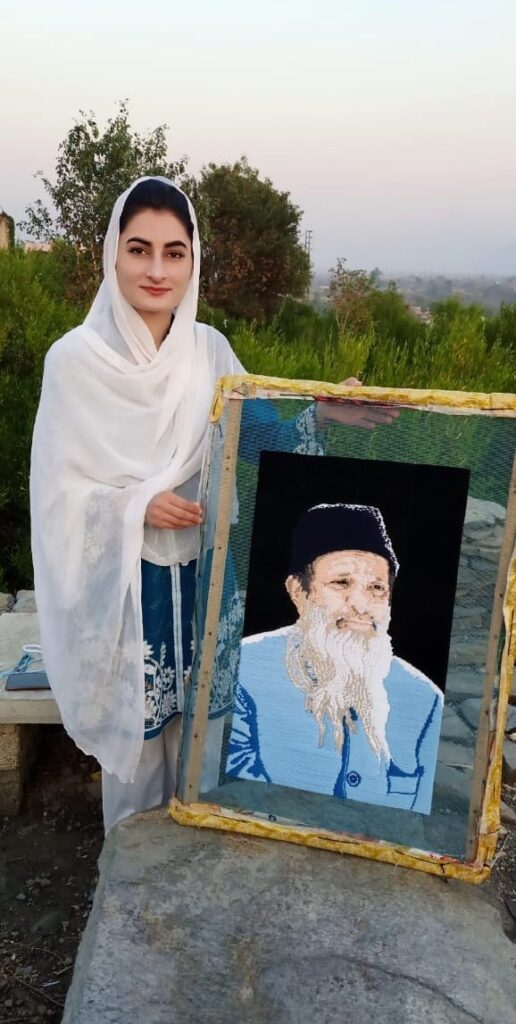
Almas Edhi is one of the four children of the renowned Pakistani philanthropist Abdul Sattar Edhi and his wife, Bilquis Bano Edhi. She, along with her siblings Faisal, Kubra, and Zeenat, is involved with continuing the philanthropic work of the Edhi Foundation.
Abdul Sattar Edhi Net worth
Abdul Sattar Edhi did not have a personal net worth in the traditional sense, as his life was dedicated to philanthropy and the operations of the Edhi Foundation, which was funded through donations. He and his wife, Bilquis Edhi, lived modestly, with Edhi famously being known as “The Richest Poor Man” due to his immense dedication to helping others rather than accumulating personal wealth.
His exclusive services to the mankind, with exclusive reference to shrouding and then burying unclaimed and abandoned dead-bodies, at a time, when there is no value of any human being, as extremists of the modern times are cutting the healthy and live human beings into pieces like onions and tomatoes, at such time, Edhi’s role for the humanity – is truly unparalleled and unmatched, and very least possibilities of tracing this sort of best services for the humanity, across the world.
This is something indicating towards a reality that there is no place of goodwill, love and affection, brotherhood and amity, feelings of friendliness yet by serving to the humanity, Edhi has given a new meaning to the life that everyone should forward to give goodwill, love and affection, brotherhood and affection, and feelings of friendliness to others – again a matter of pride for Edhi.
The story of services – in the explainer video explained by Edhi can also be listened and to get more updates about the Edhi’s role for the humanity.
Early life of EDHI
Edhi was a Gujarati Muhajir born into a Memon Muslim family in Bantva, Gujarat, India. He publicly expressed that he was not a “very religious person”, and that he was “neither for religion or against it”. On his faith, he stated that he was a “humanitarian”, telling others that “empty words and long phrases do not impress God” and to “show Him your faith” through action. His mother had brought him up teaching love and care for humans.
Edhi Foundation and Bilquis Edhi Trust
Edhi dedicated his life to aiding the poor. Over the course of sixty years, he single-handedly changed the face of welfare in Pakistan. He founded the Edhi Foundation.] Edhi was known for his ascetic lifestyle, owning only two pairs of clothes, never taking salary from his organization, and living in one room with kitchenette at the Foundation’s headquarters in the heart of Karachi. Additionally, his previously established welfare trust, named the Edhi Trust, was restarted with an initial sum of Rs.5000. The trust was later renamed after his wife as the Bilquis Edhi Trust.[28] Widely regarded and respected as a guardian and savior for the poor, Edhi began receiving numerous donations which allowed him to expand his services. As of 2016, the Edhi Foundation continues to grow in both size and service and currently remains the largest welfare organization in Pakistan. Since its inception, the Edhi Foundation has rescued over 20,000 abandoned infants, rehabilitated over 50,000 orphans, and has trained over 40,000 nurses. It also runs more than 330 welfare centres throughout rural and urban Pakistan that operate as food kitchens, rehabilitation homes, shelters for abandoned women and children, and clinics for the mentally and physically challenged
The Edhi Foundation is funded entirely by private donations and full services are offered to people irrespective of ethnicity, religion or status. It runs the world’s largest volunteer ambulance service (operating over 1,500 of them) and offers 24-hour emergency services. It also operates free nursing homes, orphanages, clinics, women’s shelters, and rehabilitation centres for drug addicts and the mentally ill.[32] Outside of its main base of operations in Pakistan, the Edhi Foundation has run relief operations in South
Asia, the Middle East, Africa, the Caucasus region, Eastern Europe, and the United States. In 2005, the foundation
donated US$100,000 to relief efforts after Hurricane Katrina As of 2020, the Foundation has international head offices present in the United States, United Kingdom, United Arab
Emirates, Canada, Australia, Nepal, Bangladesh, India and Japan.
In 2004, Edhi and his organization ran into trouble with Pakistani militants In 2014, the foundation was targeted and robbed of approximately US$500,000 and has been the victim of right-wing attacks and competition from Pakistan’s militant far-right
Travel issues which EDHI Face
In the early 1980s, Edhi was arrested by Israeli troops while he was entering Lebanon. In 2006, he was detained by authorities in Toronto, Canada, for over sixteen hours. In January 2008, U.S. immigration officials at the John F. Kennedy International Airport in New York City investigated him for over eight hours after seizing his passport and other documents. When asked by media officials about the frequent detentions, Edhi said: “The only explanation I can think of is my beard and my dress.” His appearance in traditional Pakistani clothing and a long beard made him appear visibly Muslim and therefore, in a post-9/11 climate, prompted U.S. and Canadian travel authorities to keep him for additional questioning
Life in Karachi
In 1965, Edhi married Bilquis Bado, a nurse who worked at an Edhi Trust dispensaryThey had four children, two daughters, and two sons
Bilquis became responsible for running the free maternity home at the foundation’s headquarters in
Mithandar, Karachi, where she raised her children on the top floor, and on the lower floors, ran the local delivery room, and organised the adoption of abandoned babies. These were babies who were dropped into a cradle placed outside every Edhi centre across the country or found dumped in trash piles in the streets. Often such babies were otherwise at risk of being killed because of being born out of wedlock or due to rape.[39]
On 25 June 2013, Edhi was hospitalised at SIUT due to failing kidneys. He would reportedly be on dialysis for the rest of his life unless he found a kidney donor
The daily operations of the organization during his ill health and after his passing were managed by his son Faisal Edhi (under the mentorship of Anwar Kazmi, ‘the Maulana’s Lieutenant’, as his friend Eqbal Ahmad called him), wife Bilquis Edhi (1947-2022), and daughter Kubra (who runs the Edhi center for women and children at Clifton
International award given to EDHI
- Ramon Magsaysay Award for Public Service (1986)
- Lenin Peace Prize (1988
- Paul Harris Fellow from Rotary International (1993)[51]
- Peace Prize from the former USSR, for services during the Armenian earthquake disaster (1988)[52]
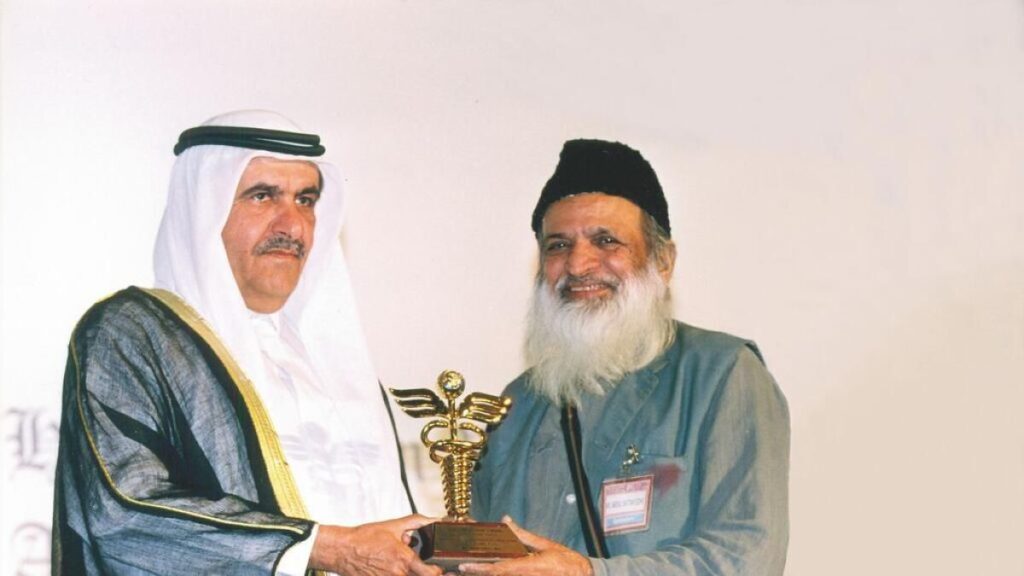
- Hamdan Award for volunteers in Humanitarian Medical Services (2000),
- International Balzan Prize (2000) for Humanity, Peace and Brotherhood,
- Peace and Harmony Award (2001), Delhi[citation needed]
- Peace Award (2004), Mumbai[citation needed]
- Peace Award (2005), Hyderabad, India[citation needed]
- Seoul Peace Prize (2008),
- Honorary doctorate from the Institute of Business Administration, Karachi (2006).
- UNESCO-Madanjeet Singh Prize (2009
- POSCO TJ Park Prize (2009)
- Ahmadiyya Muslim Peace Prize (2010)
- Honorary Doctorate by the University of
Bedfordshire (2010London Peace Award
(2011), London
In early 2016, a petition signed by 30,000 for a Nobel Peace Prize for Edhi was moved by Ziauddin Yousafzai, the father of Malala YousafzaiIn her condolence message on Edhi’s death, broadcast by BBC Urdu, Malala said that “as a Nobel Peace Prize winner, I hold the right to nominate people for the prize and I have nominated Abdul Sattar Edhi” adding that “even the coveted Nobel Prize cannot be a befitting tribute to Edhi’s services for humanity
Death of EDHI
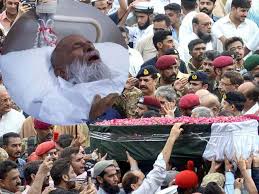
Edhi died on 8 July 2016 at the age of 88 due to kidney failure after having been placed on a ventilator. One of his last wishes was that his organs be donated for the use of the needy but due to his poor health, only his corneas were suitable for donationIn accordance with his wishes, his corneas were donated to two blind people
State funeral
Prime Minister Nawaz Sharif declared national mourning on the day following Edhi’s death and announced a state funeral for him. He became the third person in Pakistan’s history to receive a state gun carriage funeral after Muhammad Ali Jinnah and Zia-ulHaq. He was the only Pakistani without a state authority or a state role to receive a state funeral. According to the Inter-Services Public Relations (ISPR), state honors were given to Edhi by a guard of honor and a 19-gun salute. Following the funeral he was laid to rest at Edhi Village on the outskirts of Karachi
Condolences
The attendees at his Janazah (Islamic funeral prayer) included dignitaries such as Mamnoon Hussain (President of Pakistan), Raza Rabbani (Chairman of the Senate of
Pakistan), Ishratul Ibad (Governor of Sindh), Syed Qaim Ali
Shah and Shehbaz Sharif (the Chief Ministers of
Sindh and Punjab, respectively), Raheel Sharif (Chief of Army
Staff) along with Muhammad Zakaullah and Sohail
Aman (the Chiefs of Staff of the Pakistani Navy and Air Force), at the National Stadium, Karachi.[45][46] Prominent Pakistani
figures such as Maulana Tariq
Jamil[47] and Pakistani−Canadian Sheikh Faraz
Rabbani[48] often expressed their strong support for Edhi and his work.
Reactions to his death came from several high-ranking Pakistani officials, with then-Prime Minister Nawaz Sharif saying in an official statement: “We have lost a great servant of humanity. He was the real manifestation of love for those who were socially vulnerable, impoverished, helpless, and poor.”[12] Chief of Army Staff Raheel Sharif called him a “true humanitarian”.[3] He was called Pakistan’s equivalent of Mother Teresa by India Today in 1990,[citation needed] and the BBC wrote that he was considered “Pakistan’s most respected figure and was seen by some as a saint.”[12]